Your Zip Code Should Not Decide the Quality of Your Healthcare

Inside Vytal Health Solutions, A Cognigence Portfolio Spotlight
Abstract
Healthcare quality should not depend on a patient's zip code. This article examines the growing access gap facing rural, low-income, uninsured, and underserved communities, where hospital closures, provider shortages, limited broadband, and fragmented telehealth systems continue to delay or prevent care. It explores how Vytal Health Solutions is addressing these barriers through a comprehensive TeleHealth Operating System that combines AI, machine learning, natural language processing, blockchain, remote monitoring, behavioral health, and other connected care tools in one platform. The article also explains why Cognigence invested in Vytal, highlighting its rare alignment between advanced MedTech and health equity, its potential for measurable social impact through earlier and more accessible care, and its strong fit for Harvard SROI measurement. At its core, Vytal is building the infrastructure needed to make “Care Anywhere” a measurable reality, not a privilege determined by geography.
There is a version of healthcare that works extraordinarily well. World-class specialists. Advanced diagnostics. Cutting-edge treatments available within a short drive. If you live in the right place, have the right insurance and speak the right language, the system will very likely save your life.
Then there is the other version. The one where the nearest hospital closed last year. Where the nearest specialist is a four-hour drive and a full day of lost wages away. Where telehealth exists in theory but your broadband does not. Where the intake forms are only in English, the appointment portal requires digital literacy you were never taught, and the emergency room is the only healthcare you have ever actually been able to access.
Same country. Same medicine. Radically different outcomes.
The variable is not the science, it is the zip code.
That is the problem Vytal Health Solutions built its entire platform to solve. And it is why Cognigence invested in them.
The Access Crisis: What Is Actually Happening to American Healthcare Geography
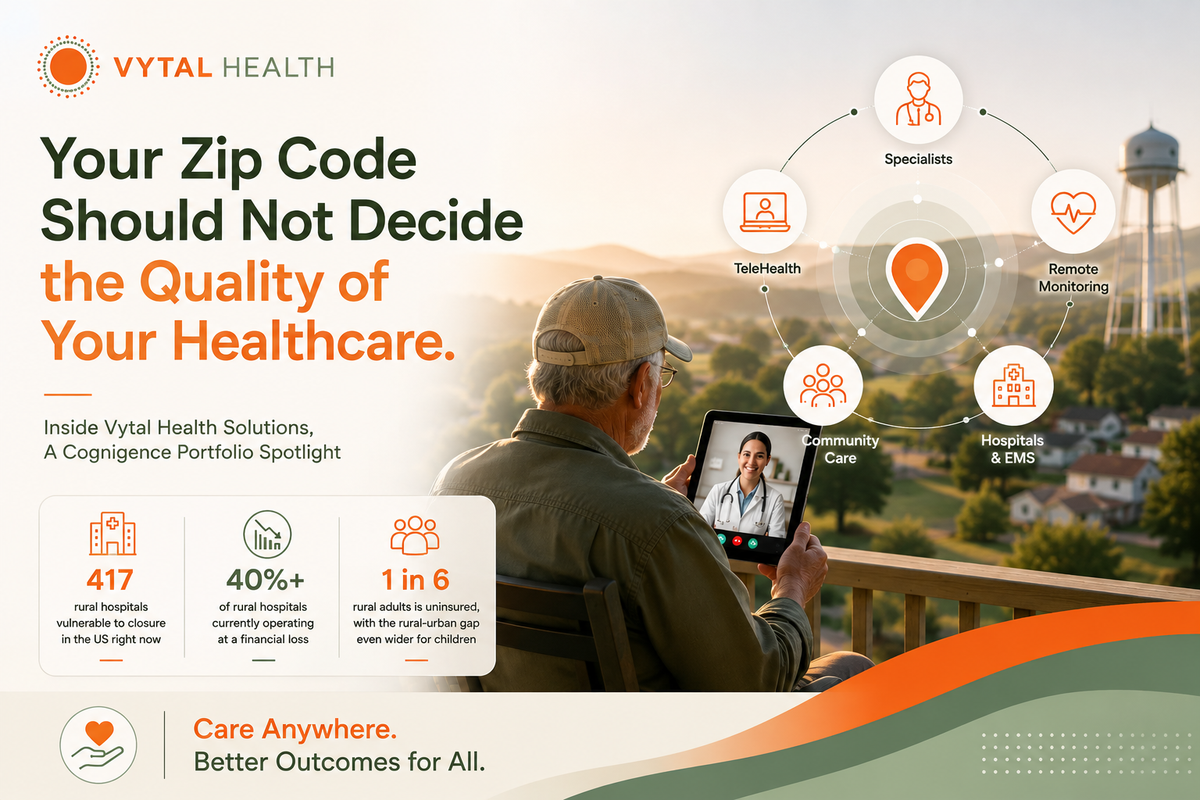
The rural health safety net in the United States is under sustained structural strain. Chartis's 2026 Rural Health State of the State analysis found that more than 40% of rural hospitals are operating at a loss, leaving 417 facilities vulnerable to closure. More than 300 hospitals have already eliminated obstetric services entirely, meaning expectant mothers in those communities now drive hours to deliver, or don't make it in time.
When a rural hospital closes, the effect is not just the loss of a building. It is the loss of the emergency department, the loss of local specialists, the loss of the pharmacy relationships, the loss of the jobs that anchored the local economy, and the loss of the informal care network that formed around all of it. Communities do not simply drive further for the same care. They receive less care, later, in worse condition.
Telehealth was supposed to be the answer, and in principle, it is. A specialist consultation does not require the patient and the physician to be in the same building. Remote patient monitoring can catch deterioration earlier than periodic office visits. Virtual behavioral health can reach people who would never make it to an in-person appointment.
But telehealth only closes the gap if it actually reaches the people on the wrong side of it. And as HealthTech's 2026 analysis of the digital health divide documents, patients in rural communities without reliable broadband often cannot access telehealth services at all, so they miss work and travel hours to see a doctor, or they simply don't go. When those barriers exist, people delay care, and they often don't seek treatment until they are sick enough to require an emergency visit. That is the most expensive and least effective point of entry into the healthcare system.
Who Is Actually Being Left Out, and What It Costs Them
Health equity in telehealth means the opportunity for everyone to receive the healthcare they need and deserve, regardless of social or economic status. Achieving it requires deliberate work across digital literacy, technology design, and analytics, not just making a video platform available and assuming access follows.
Vytal's own health equity framework identifies both who is being excluded and what that exclusion produces:
The barriers that produce these outcomes are specific and, importantly, solvable. They include lack of video-capable devices, spotty or absent internet access, lack of housing or private space to participate in a virtual visit, few local providers offering telehealth, language barriers across oral, written, and signed language, and lack of adaptive equipment for people with disabilities.
Note what is not on that list: a lack of medical knowledge or clinical capability. Every one of these barriers is an access and infrastructure problem. Which means every one of them can be addressed by technology designed with equity as a requirement rather than an afterthought.
What Vytal Built: A TeleHealth Operating System, Not Another Video App
Most telehealth companies solve one narrow piece of the problem. One vendor for video visits. Another for remote patient monitoring. Another for e-prescribing. Another for the EHR. Another for behavioral health. Health systems end up patching together six or seven vendors, none of which talk to each other, each with its own login, its own data silo, and its own contract.
For a large urban health system with a dedicated IT department, that is expensive and annoying. For a rural critical access hospital operating at a loss with two IT staff, it is impossible, which is precisely why the communities that need virtual care most are the ones least likely to have it.
Vytal's answer was to build a comprehensive TeleHealth Operating System: a single platform designed so that organizations do not need to assemble a patchwork of technology vendors. One solution, covering the full breadth of virtual care delivery, at a cost structure that makes adoption realistic for under-resourced providers.
The platform spans a remarkably broad set of focus areas for a single solution: healthcare operating system infrastructure, EHR, population health management, urgent care, telehealth, emergency services, remote patient monitoring, the Internet of Medical Things, health equity, labs, discharge support, behavioral health, and communications.
Vytal combines nearly two decades of telehealth experience with an understanding of the payer world, which matters more than it might appear. A telehealth platform that cannot be reimbursed is a pilot program, not a healthcare service. Vytal is designed to work within existing healthcare and payer systems to be fully reimbursed, reach underserved demographics, and deliver higher patient outcomes at a lower cost than traditional delivery. It is not a workaround that bypasses the system. It is infrastructure that makes the existing system work for the people it currently fails.
The Reimbursement Problem, and Why It Matters More Than the Technology
There is an uncomfortable truth in digital health that rarely makes it into press releases: the technology has largely been solved. Video consultation works. Remote monitoring devices work. AI triage works. The reason virtual care has not transformed access for underserved populations is not technological. It is financial and regulatory.
Telehealth reimbursement in the United States remains unsettled. Pandemic-era Medicare flexibilities have been extended but not made permanent. Only about half of states require commercial insurers to reimburse telehealth at parity with in-person visits, and even where parity laws exist, scope and enforcement vary considerably. For a critical access hospital or rural health clinic operating on razor-thin margins, committing capital to telehealth infrastructure against a reimbursement model that could change is a genuine risk, and one many simply cannot take.
This is why Vytal's payer-world expertise is not a footnote in its value proposition. It is central to it. A platform built by people who understand reimbursement mechanics is a platform that under-resourced providers can actually deploy without betting their solvency on regulatory stability. Cost-effectiveness and reimbursability are not features layered on top of the clinical product. They are what determine whether the clinical product ever reaches a patient in a rural county.
Fragmented Telehealth vs. the Vytal Model
Why Cognigence Invested in Vytal
Cognigence evaluates every portfolio investment against three questions: Does it produce measurable social impact? Does it have the potential for financial return? Can both be measured and reported transparently? Vytal is one of the strongest cases in our portfolio for a reason that is easy to miss.
It Sits at the Intersection of Two Cognigence Focus Areas
Vytal is a MedTech investment and an Underprivileged investment simultaneously. The technology is genuinely advanced, AI, machine learning, natural language processing, blockchain, which places it squarely in Cognigence's MedTech focus area. But the populations it is explicitly designed to serve are the populations our Underprivileged focus area exists for: low-income Americans, rural communities, immigrants, the uninsured and underinsured, people with disabilities, and those with limited English proficiency.
Most healthcare technology investments serve one or the other. They are either sophisticated and aimed at well-resourced health systems, or they are equity-focused and technologically modest. Vytal is deliberately both, and that combination is rare enough that it represents genuine differentiation, not just good positioning.
The SROI Case Is Unusually Strong
Healthcare access interventions produce some of the highest measured social returns available, because the downstream costs of inaccessible care are so enormous. A patient who receives a virtual specialist consultation early avoids the emergency department visit, the late-stage diagnosis, the extended hospitalization, and the medical debt that would otherwise follow. Each of those avoided costs is quantifiable in dollar terms, which makes Vytal's impact exceptionally well-suited to Harvard SROI analysis.
The equity dimension amplifies the return further. The same telehealth consultation delivered to a well-insured urban patient with an existing primary care relationship produces real but modest value, they had other options. Delivered to an uninsured rural patient whose nearest hospital closed, it may be the difference between an early intervention and a preventable death. The marginal social value of healthcare access is highest exactly where access is currently lowest, which is precisely where Vytal aims.
The Philosophical Alignment
Vytal's use of blockchain for data integrity mirrors Cognigence's own conviction: in systems where trust and accountability have broken down, verification should be structural rather than optional. And its founding premise, that the quality of care you receive should not be determined by your zip code, is a restatement of Cognigence's own commitment to funding solutions that benefit all people, regardless of origin, race, politics, religion, or status of life.
Care Anywhere Is Not a Slogan. It Is a Measurable Standard.
Four hundred and seventeen rural hospitals are vulnerable to closure. More than 40% are operating at a loss. Three hundred communities have lost obstetric care. One in six rural adults is uninsured. These are not projections about a future crisis, they describe the healthcare geography of the United States right now.
The medicine to treat these communities exists. The specialists exist. The diagnostic technology exists. What does not exist, in far too many places, is a delivery mechanism that can get any of it to the people who need it, at a cost their local providers can sustain and through a reimbursement pathway that does not collapse the moment policy shifts.
That is the gap Vytal was built to close, and it is why Cognigence's MedTech focus area directs donor capital toward it. When you give to Cognigence, you are not funding a general healthcare fund. You are backing specific infrastructure that determines whether a patient four hours from the nearest specialist ever sees one.
Every dollar is tracked on blockchain from the moment you donate. Harvard SROI measures what it accomplishes. Only $0.25 per dollar goes to operations. And through our equity gifting model, when portfolio companies like Vytal succeed, a portion of that upside returns to the donors who made it possible.