The Compounding Gift: Why Cognigence Invests in Education as the Highest-Leverage Path Out of Poverty

Abstract
Poverty relief can address an immediate need, but lasting poverty reduction requires interventions that change what happens next. This article examines why education, particularly entrepreneurial education combined with financial literacy and access to capital, can generate stronger long-term social returns than short-term assistance alone. Drawing on global education and learning poverty data, the analysis explores the enormous economic cost of educational exclusion and explains why simply increasing school enrollment is not enough when millions of students still leave school without the skills needed to earn or create sustainable income. The article then examines Cognigence’s approach to funding entrepreneurial education, technology-enabled learning, financial capability, and credit access as interconnected drivers of economic mobility, while using blockchain tracking and Harvard SROI to measure outcomes over longer investment horizons. At its core, the article asks a simple but important question: what if the most effective way to fight poverty is not to keep providing the next meal, but to give people the knowledge, skills and capital to provide it for themselves?
There is a reason the phrase "give a man a fish" has survived for centuries. Everyone intuitively understands the difference between relieving a need and removing it.
And yet the overwhelming majority of charitable capital directed at poverty goes to the fish.
Food assistance. Emergency shelter. Utility relief. Cash transfers.
All of it genuinely necessary, all of it genuinely good and almost none of it changing the conditions that made the assistance necessary in the first place. Next year, the same household needs the same help.
Cognigence takes a different position. Not that emergency relief is wrong but that a venture philanthropy organization, one built specifically to apply investment discipline to social outcomes, has an obligation to fund the interventions with the highest long-term return. And across every serious analysis of poverty reduction, one intervention consistently outperforms the rest.
Education. Specifically: education paired with the practical, entrepreneurial and financial capability to use it.
The Education Crisis Is Getting Worse, Not Better
The headline number from UNESCO's 2026 Global Education Monitoring Report is stark: 272 million children and young people are out of school worldwide and that figure has now risen for seven consecutive years. One in six school-age children globally is excluded from education entirely. Only two in three students complete secondary school.
But the deeper problem is not attendance. It is learning. A child can be enrolled, present and counted in the statistics while learning almost nothing and that is happening at enormous scale.
The World Bank and UNESCO track this with a measure called learning poverty: the share of 10-year-olds who cannot read and understand a simple story. Across low- and middle-income countries, that figure is 53%. In sub-Saharan Africa it reaches 86%. In the poorest countries it approaches 93%, for boys and girls alike. These are children who are in school and still cannot read.
The economic consequence is measurable and staggering. The World Bank estimates that this generation of students risks losing $21 trillion in lifetime earnings, roughly 17% of current global GDP. That is not a moral abstraction. It is a quantified, compounding loss of human potential that will constrain economies for the next half-century.
And the spending gap that produces it is almost absurd in its simplicity: high-income countries spend approximately $8,543 per student annually. Low- and middle-income countries spend approximately $55.
Why Education Produces the Highest Social Return of Any Poverty Intervention
Cognigence evaluates every deployment of donor capital using the Harvard Social Return on Investment framework, quantifying the dollar value of social outcomes produced per dollar invested. Under that lens, education consistently outperforms almost every alternative. Four structural reasons explain why.
Beyond the Classroom: Why Cognigence Funds Entrepreneurial Education
Here is where Cognigence's approach diverges from conventional education philanthropy.
Traditional education giving tends to stop at the schoolhouse: build classrooms, supply textbooks, fund teacher salaries, provide scholarships. Those things matter enormously. But they carry an implicit assumption that once a person is educated, a functioning job market will be waiting to absorb them.
In much of the world, it will not. Youth unemployment in many developing economies exceeds 30%. Formal-sector employment absorbs a fraction of new graduates each year. A person can complete secondary school, or even university and find no path from that credential to an income.
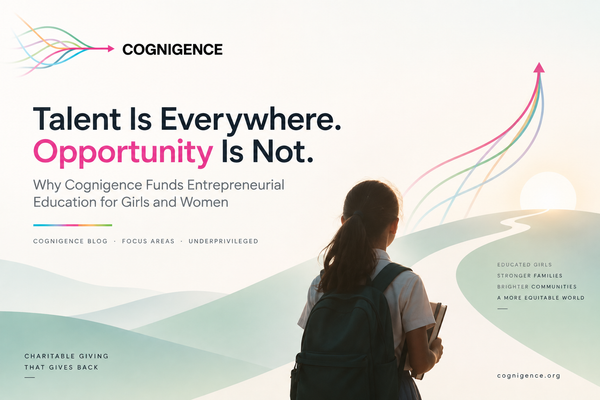
This is why Cognigence's Innovation Support services centre on entrepreneurial education, teaching people not only to qualify for jobs, but to create them. And the research supporting this approach is unusually clear. A peer-reviewed study in Frontiers in Sociology analyzing community entrepreneurship programs found that three factors independently and significantly reduce poverty: entrepreneurship education, budgeting and financial literacy and access to credit facilities.
Note the composition of that finding. Not one intervention, three, working together. Teaching someone to run a business without financial literacy produces a business that cannot manage its own cash flow. Providing credit without entrepreneurship education produces debt rather than enterprise. Delivering education without capital access produces capable people with no means to act on their capability.
Cognigence's Underprivileged focus area is built around funding all three together, because the evidence indicates that is the combination that actually moves people out of poverty.
What a $1,000 Education Investment Looks Like Over Time
The reason education outperforms emergency relief on SROI is not visible in year one. In year one, food assistance produces an obvious, immediate, measurable benefit and education produces almost nothing observable. The divergence appears over a realistic time horizon, which is exactly why annual grant cycles systematically underfund it.
Here is the trajectory Cognigence underwrites when it deploys donor capital into entrepreneurial education:
Across a ten-year horizon, well-designed entrepreneurial education programs consistently produce social returns in the range of three to eight dollars for every dollar invested, with the wide range reflecting differences in local market conditions, credit access and program quality rather than uncertainty about direction.
An emergency food grant of the same size produces a return that is real, immediate, humane, and finished.
Relief Funding vs. Education Investment
How Cognigence Deploys Education Capital
Cognigence's education work sits inside the Underprivileged focus area and operates through the same three mechanisms that govern every deployment of donor capital: grants and research, direct funding for causes and investments that produce both social good and financial return.
Entrepreneurial Education Programs
Direct funding for programs teaching business fundamentals, financial literacy and enterprise development in underserved communities. Programs are selected on measurable outcomes, business formation rates, employment generated, income change over baseline, not on activity volume or enrollment counts.
Financial Literacy and Credit Access
Because the research shows entrepreneurship education, budgeting literacy and credit access work as a system rather than in isolation, Cognigence funds them together. Training without capital access produces frustration; capital without training produces default. The combination produces enterprises.
Education Technology in Underserved Markets
Where Cognigence's MedTech investment thesis identifies technology that extends healthcare into communities the market ignores, the same logic applies to education. Platforms that deliver instruction, credentialing and skills training at low marginal cost can reach populations that traditional educational infrastructure will not serve for decades. This sits at the intersection of the Underprivileged and technology investment theses.
Blockchain-Verified Outcome Tracking
Every dollar directed to education programs is recorded on Cognigence's blockchain ledger from donation through deployment. Donors can verify where their capital went. Harvard SROI analysis then quantifies what it produced. Only $0.25 per dollar is consumed by operations, meaning $0.75 of every dollar reaches the programs themselves, against a US nonprofit average of $0.20 to $0.50.
The Case for Patient Capital in Education
Education is underfunded in philanthropy for a structural reason that has nothing to do with anyone doubting its value. It is underfunded because its returns arrive on a timescale that annual grant cycles, quarterly reporting and campaign-driven fundraising cannot accommodate.
An organization that must demonstrate impact within twelve months will fund the food bank. It is the rational choice given the constraint. The problem is the constraint, not the judgment.
Venture philanthropy exists precisely to remove that constraint. Venture capital funds companies that will not be profitable for seven years because the eventual return justifies the wait. Cognigence applies the same logic to social outcomes: fund the intervention with the highest long-run return, measure it honestly with Harvard SROI and hold the position long enough for the compounding to occur.
Two hundred and seventy-two million children are out of school. Fifty-three percent of ten-year-olds in low- and middle-income countries cannot read a simple story. Twenty-one trillion dollars in lifetime earnings hangs on whether that changes.
The fish matters. Someone is hungry today and needs to eat today. But if every philanthropic dollar goes to the fish, the fishing never gets taught, and the same hungry households return next year and the year after and the generation after that.
Cognigence funds the teaching. Tracked on blockchain. Measured by Harvard SROI. Held long enough to work.