90% of Carbon Credits Still Run on Paper Surveys and Manual Audits - A Cognigence Portfolio Spotlight

Abstract
Carbon markets have a data problem: when emissions reductions are measured through periodic site visits, manual audits, and self-reported information, even a legitimate carbon credit can be difficult to verify with confidence. This article examines the data infrastructure behind Qritos, a Cognigence Green Earth portfolio company, and how it uses digital MRV, blockchain, AI, machine learning, historical energy analysis and confidence scoring to turn fragmented environmental data into continuously verifiable evidence. Beyond explaining the technology, the article explores the measurable results already associated with the platform, including 4–8x faster certification, 5x faster audits, a 40% reduction in operational costs and a 50% increase in credit value. It also examines a deeper question: what happens when the data layer itself becomes the source of trust in a market worth trillions? For Cognigence, that is what makes Qritos more than a climate-tech investment, it is an opportunity to strengthen the infrastructure through which global climate finance is measured, verified and deployed.
Here is how a significant share of the world's carbon credits are still verified in 2026: someone gets on a plane, drives to a facility, walks around with a clipboard, reviews paperwork the facility prepared itself and signs off.
That is not a caricature. It is a description of standard practice across a market that channels billions of dollars in climate finance every year and forms the backbone of corporate net-zero commitments worldwide.
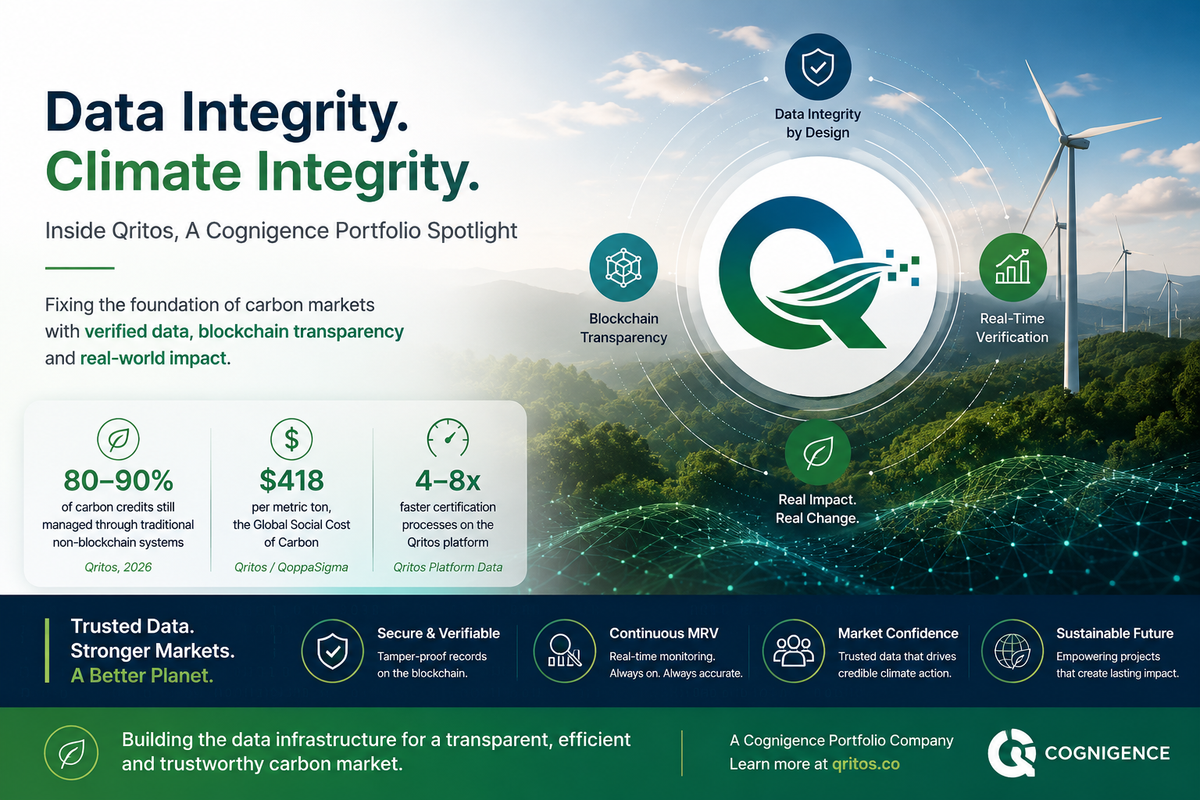
According to Qritos, the global carbon credit market remains inefficient, fragmented and lacking in transparency, with 80 to 90% of carbon credits still managed through traditional, non-blockchain systems. These systems rely on paper surveys and manual audits: traveling to facilities for on-site reviews and relying on unverified promises. The result is exactly what you would expect, significant trust issues and a fundamental lack of reliability in carbon credit transactions.
Qritos is one of Cognigence's Green Earth portfolio companies and it exists to solve that problem at its root. Not by building another carbon marketplace or another registry, but by fixing the layer beneath all of them: the integrity of the data itself.
The Real Problem With Carbon Credits Is Not Fraud. It Is Data.
Most public criticism of carbon markets focuses on bad actors, companies that bought worthless offsets, projects that overstated their impact, registries that let low-quality credits through. That criticism is often warranted. But treating the problem as primarily one of dishonesty misses the deeper structural issue.
The reason low-quality credits enter the market is that the verification infrastructure was never built to catch them. When verification depends on periodic site visits, self-reported facility data and manual auditing on annual timeframes, there is no continuous check on whether a claimed reduction actually happened. An auditor visiting once a year cannot detect what a facility's energy systems did in the intervening eleven months. The system is not primarily being cheated, it is being asked to certify things it has no mechanism to observe.
This produces four compounding failures. Originators face high costs and deep uncertainty just to enter the market. Auditors report slowly with limited data. Standards bodies certify slowly, working from low-quality reports. Marketplaces cannot guarantee integrity. And consumers, the companies actually buying credits to meet climate commitments, genuinely do not know which credits to trust or what claims they are entitled to make.
What Qritos Built: Data Integrity as Infrastructure
Qritos describes itself as the only platform currently focused on providing data integrity in the carbon credit industry, and that framing is deliberate. The company is not competing with registries or marketplaces. It sits underneath them, building the verified data layer that everything above it depends on. Its Carbon Data Management infrastructure has been developed over the past decade with secure data as a core design value.
The platform operates across four integrated capabilities:
Why Digital MRV Is the Critical Piece
Measurement, Reporting and Verification is the technical backbone of every carbon credit ever issued. It is the process that turns a claim, we reduced emissions by X, into a certified, tradeable asset. Traditional MRV is manual, periodic and dependent on the good faith of the party being measured.
Digital MRV built on blockchain changes the trust model entirely. Every data point, every adjustment, every transformation is recorded in a tamper-proof ledger. When Qritos attaches a confidence score to a dataset, that score is backed by an auditable trail showing exactly where the data came from and how it was processed. An auditor no longer has to take a facility's word for it, or fly out to check. The data carries its own proof.
QoppaSigma: A Carbon Currency Anchored to the Social Cost of Carbon
The most distinctive element of the Qritos platform is QoppaSigma, a stable cryptocurrency tied to the Global Social Cost of Carbon at $418 per metric ton.
That design choice deserves attention, because it addresses one of the most persistent problems in voluntary carbon markets: price incoherence. Carbon credits have historically traded anywhere from a few dollars to over a hundred dollars per tonne, with price driven largely by project type, registry and buyer sophistication rather than by the actual social cost of the emissions in question. That volatility makes carbon credits unreliable as financial instruments and, worse, allows buyers to satisfy climate commitments with the cheapest available credits regardless of quality.
Anchoring to the Social Cost of Carbon, the economic estimate of damages caused by emitting one additional tonne of CO₂, inverts that logic. It ties the value of the instrument to the actual harm being offset rather than to market appetite for cheap paper. For businesses, this transforms carbon reductions into measurable financial returns while aligning with ESG mandates. For the climate, it means the price signal reflects the stakes.
The Measured Results
What separates Qritos from most climate-tech propositions is that the platform's benefits are quantified rather than asserted:
These numbers matter for a reason that is easy to overlook. High auditing costs and slow certification timelines are not merely inefficiencies, they are barriers to entry. A small facility with genuine energy efficiency improvements often cannot justify the cost and delay of certification, so its real emissions reductions never become credits and never attract climate finance. Cutting certification time by four to eight times and audit costs by 40% does not just make existing participants more efficient. It brings participants into the market who were previously priced out entirely.
And a 50% increase in credit value reflects something important about how trust translates into economics: a credit whose underlying data can be independently verified is worth substantially more than one that cannot. Integrity is not a compliance cost. It is a value driver.
What Changes for Everyone in the Carbon Value Chain
Qritos connects stakeholders across the entire carbon value chain, and the improvement is not concentrated in one place. Each actor gets something specific:
Note the pattern: this is not a platform that wins by taking margin from one party and giving it to another. The gains come from removing friction that was destroying value for everyone simultaneously. When verification is slow and untrustworthy, originators overpay to enter, auditors work with bad inputs, standards bodies certify slowly, marketplaces carry reputational risk and buyers hedge by paying less. Fix the data layer and every one of those problems improves at once.
Beyond Carbon: The Analytics Platform Underneath
Qritos's carbon credit work sits on top of a broader data analytics capability. Its services span data collection and integration, preprocessing and cleaning, energy analytics, predictive analytics and forecasting, optimization and decision support, reporting and visualization, verification and compliance, security and privacy management and continuous improvement.
The energy analytics work is particularly rigorous. Qritos applies the International Performance Measurement and Verification Protocol, the recognized global standard for quantifying energy savings, across all four of its measurement options, from key parameter measurement through calibrated simulation. Machine learning models incorporate relevant attributes like weather, temperature, loads and operating times to increase sensitivity, meaning the platform can distinguish an actual efficiency improvement from a mild winter.
That distinction sounds technical. It is the entire ballgame. A carbon credit issued because a facility used less energy during an unusually warm season is not a real reduction, and traditional verification frequently cannot tell the difference. Qritos can.
On the compliance side, the platform compares reported data against independent sources, maintains detailed audit trails of every data change and access event, monitors regulatory adherence, supports certification processes and runs automated AI-driven auditing that continuously verifies data integrity rather than checking once a year.
Why Cognigence Invested in Qritos
Cognigence evaluates every portfolio investment against three questions: Does it produce measurable environmental or social impact? Does it have the potential for financial return? Can both be measured and reported transparently? Qritos is among the strongest cases in our portfolio, for reasons that go beyond the climate category.
It Operates at the Leverage Point
Most climate philanthropy funds projects, a solar installation, a reforestation initiative, an efficiency retrofit. Those projects matter enormously. But Qritos operates one layer beneath all of them, at the infrastructure level: it fixes the mechanism through which climate capital reaches every such project.
If carbon markets function with integrity, capital flows efficiently to high-quality climate work at scale. If they don't, the entire market-based climate finance apparatus underdelivers regardless of how many individual projects get funded. Investing in the verification layer is therefore one of the highest-leverage climate investments available, it improves the efficiency of an entire global capital allocation system rather than funding one project at a time.
The SROI Case Is Unusually Measurable
Climate impact is notoriously difficult to quantify, which is why so much environmental philanthropy resorts to vague outcome language. Qritos has the opposite problem, it generates impact data as a native output of its core operations. Every verified credit represents emissions genuinely avoided or removed, attributable and permanently recorded. The 40% operational cost reduction, 5x audit acceleration and 50% credit value increase are directly measurable.
For Harvard SROI analysis, this is close to ideal. Cognigence can report to donors not just that their capital supported climate work, but precisely what efficiency and integrity gains it produced in the market mechanism that finances climate work globally.
The Philosophical Alignment
Qritos and Cognigence are built on the same conviction. Cognigence operates on blockchain infrastructure because we believe donor capital should be verifiable rather than merely trusted, donors should not have to take our word for where their money went. Qritos applies exactly the same principle to environmental claims: emissions reductions should be verifiable rather than merely asserted.
Both organizations start from the recognition that in systems where trust has broken down, the solution is not better promises. It is technology that makes verification structural rather than optional.
Why This Matters and What Your Donation Funds
Carbon markets are not optional infrastructure for the climate transition. Decarbonizing the global economy requires capital at a scale no government or philanthropic sector can supply alone and market mechanisms are the primary channel through which the necessary trillions will move.
Which means the integrity of those mechanisms is not a technical footnote. It is the difference between a carbon market that genuinely decarbonizes and one that generates paperwork while emissions continue. Right now, with 80 to 90% of credits still verified through paper surveys and annual site visits, we are much closer to the second outcome than the first.
When you donate to Cognigence's Green Earth focus area, your capital supports companies like Qritos that are building the trust infrastructure the transition depends on. Broader industry analysis of on-chain climate assets confirms the direction of travel: verifiable, tokenized environmental assets are becoming the standard and the organizations building that standard now will shape how climate finance operates for decades.
Your donation is tracked on Cognigence's blockchain from the moment you give. Harvard SROI measures what it accomplishes. Only $0.25 per dollar goes to operations, the rest funds the work. And through our equity gifting model, when portfolio companies like Qritos succeed, a portion of that upside returns to the donors who made the investment possible.