Spotlight: Symbio - The AI Platform Giving First Responders the Information They Need to Save Lives
Abstract
Prehospital care is one of the most information-starved environments in healthcare, where paramedics and emergency teams often make critical decisions without access to complete patient histories, encounter records, behavioral health information, or real-time hospital capacity. This article examines how fragmented communication between first responders, hospitals, and community care providers contributes to unnecessary emergency department use, delayed treatment, and missed opportunities for early intervention, particularly among behavioral health and underserved populations. It explores how Symbio’s AI-driven, HIPAA-compliant healthcare coordination platform addresses these gaps by connecting EMS teams, physicians, behavioral health providers, social services, and hospitals through real-time patient information and communication. The article further examines why Cognigence invested in Symbio, highlighting its potential to generate measurable social and economic value through improved care coordination, reduced unnecessary healthcare utilization, stronger community referrals, and greater healthcare equity.
When a paramedic arrives at the scene of an emergency, they are making decisions in seconds. Who is this patient? Have they been here before? Do they have a history of behavioral health crises? Which hospital can receive them fastest? Is there a bed available? What does the ED need to know before the ambulance pulls in?
In most of the United States today, the answer to most of those questions is: we don't know yet. The information exists, scattered across EHR systems, dispatch logs, previous encounter records and social determinant databases, but there is no single platform that pulls it together in real time, puts it in a paramedic's hands at the scene and creates a seamless communication loop between first responder, hospital and community care provider.
That is the problem Symbio was built to solve. And it is why Cognigence chose to invest in them.
The Information Gap That Costs Lives
Prehospital care, the emergency medical services rendered to patients before and during transport to a healthcare facility, is one of the most critical and most information-starved environments in medicine. The decisions made in those first minutes, at the scene and in the ambulance, directly determine patient outcomes. And they are routinely made with incomplete, delayed, or entirely absent information.
Consider behavioral health. Of the 20 million calls EMS receives annually in the US, 1.5 million involve behavioral health concerns, anxiety, substance use, acute psychiatric episodes, housing crises. That number is growing. And behavioral health calls are the ones where fragmented information causes the most harm: a paramedic who doesn't know a patient has been encountered three times in the last month for non-emergency situations will route them to an ED unnecessarily, consuming critical resources and missing the opportunity to connect them with the right community care.
The consequences extend well beyond individual calls. When EMS teams lack real-time communication with receiving hospitals, EDs cannot prepare for incoming patients. When encounter history is siloed, repeat callers cycle through the emergency system without ever being connected to root-cause care. When behavioral health cases aren't properly documented and routed, they become a criminal justice issue instead of a healthcare one, at vastly greater cost to the patient and the system.
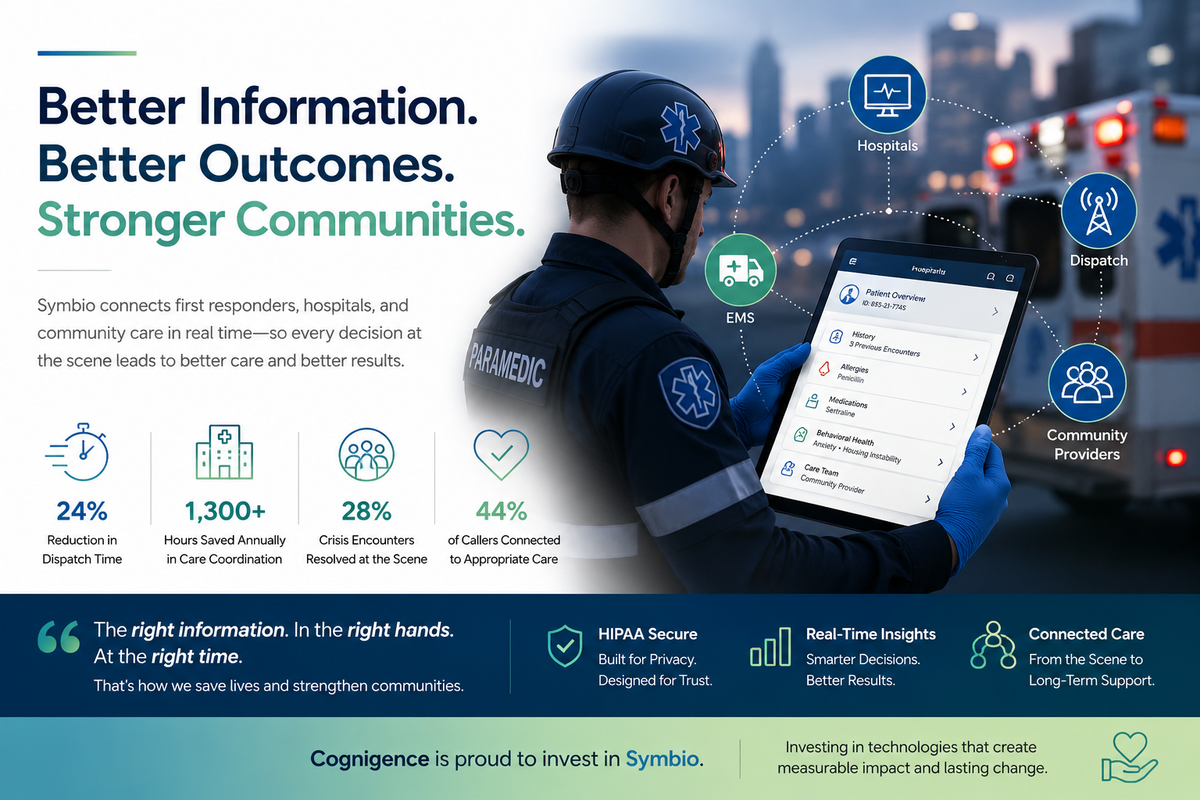
A June 2026 analysis by Bamboo Health found that integrated crisis management technology produces measurable, significant outcomes: a 24% reduction in average dispatch time, over 1,300 hours saved annually in care coordination per ED, 28% of crisis encounters resolved at the scene rather than requiring transport and 44% of callers connected to appropriate care. The technology exists. The gap is adoption and integration, which is exactly where Symbio operates.
What Symbio Does: Healthcare's Most Powerful Care Coordination Platform for First Responders
Symbio describes itself as healthcare's most powerful care coordination platform for first responders and the description is precise. It is not a dispatch tool, an EHR replacement, or a standalone communication app. It is a comprehensive platform that connects every actor in the prehospital care chain, paramedics, EMTs, dispatchers, EDs, behavioral health providers, social services and hospital administration, through a single, HIPAA-compliant, AI-driven system.
The platform operates across six solution areas, each addressing a specific gap in the current prehospital care landscape:
The Measured Value: What Symbio Produces for Every Actor in the Chain
Symbio's platform is not an improvement in one area at the cost of complexity in another. It produces measurable value for every actor in the prehospital care ecosystem simultaneously, which is why care coordination platforms are one of the highest-SROI investment categories in healthcare technology.
For EMS teams specifically: instant access to patient history and previous encounters, knowledge of what services were previously recommended, one-tap communication with hospitals and receiving facilities, HIPAA-secure photo, video and EKG sharing and real-time traffic routing. The result is faster, better-informed decisions at the point of care, which is where lives are saved or lost.
For hospital administrators: complete visibility into incoming patients before arrival, facility assignment capability from the web portal, staff alerts targeted to the right personnel and EHR integration that eliminates manual data re-entry. Every minute saved in the admission process is a minute available for patient care.
For behavioral health and community care providers: a direct, documented referral loop, close-the-loop acknowledgement that the referred patient was contacted and care was initiated. For the first time, EMS and community care are operating on the same information system, rather than passing paper referrals into a void.
Why Cognigence Invested in Symbio
Cognigence evaluates every investment against three criteria: Does it produce measurable social impact? Does it have the potential for financial return? Can both be measured and reported transparently? Symbio meets all three and in a specific way that makes it an exceptionally strong SROI opportunity.
The SROI Case
The social return on investment in care coordination infrastructure is compounding. A single avoidable ED visit costs the healthcare system an average of $2,000–$3,000 for a non-emergency case and $15,000–$100,000 for a behavioral health crisis requiring inpatient admission. When Symbio enables a paramedic to divert a non-emergency patient to the right community provider instead of the ED, as it did in the scenario above, it does not just save money on that one visit. It initiates a care relationship that prevents the next five visits.
Multiply that across 1.5 million behavioral health EMS calls annually. Multiply it across the hospitals and EMS agencies that adopt the platform. The social and economic value produced by better prehospital care coordination is not linear, it compounds at every point where a crisis is de-escalated, a patient is connected to the right provider, or an ED bed is freed for a patient who genuinely needs it.
The Market Opportunity
The prehospital care technology market is in an early but accelerating adoption phase. Most EMS agencies in the US still coordinate primarily via radio and phone calls, the technology infrastructure Symbio replaces. The addressable market is large, the competitive landscape is thin for a platform of Symbio's comprehensiveness and the regulatory and reimbursement environment is increasingly supportive of technology that reduces unnecessary ED utilization.
For Cognigence's equity gifting model, this means that as Symbio scales, across EMS agencies, hospital systems, behavioral health networks and eventually military and international markets, the financial return available to distribute to Cognigence donors scales with it.
The Mission Alignment
Symbio operates at the intersection of Cognigence's MedTech and Underprivileged focus areas. The populations most affected by behavioral health care gaps, those with housing instability, repeat crisis presentations, limited insurance coverage, are exactly the populations Cognigence's Underprivileged focus area targets. Technology that improves care coordination in the prehospital setting is not a service for wealthy, well-insured patients. It is infrastructure that most benefits the people who are currently falling through the cracks of a fragmented system.
Symbio and the Future of Prehospital Care
The direction of emergency medicine is clear: care coordination will increasingly happen before the patient reaches the hospital, not after. The 988 crisis line, mobile crisis response teams, community health workers and social determinant of health screening programs are all moving in the same direction, toward earlier intervention, more appropriate routing and better use of the full spectrum of available care resources.
Symbio is positioned at the center of that shift. Its platform is the connective tissue that makes earlier intervention operationally possible, giving first responders the information, the communication tools and the documentation infrastructure to do more than transport patients to the nearest ED and hope for the best.
For Cognigence donors, investing in Symbio through our MedTech focus area means funding the infrastructure layer of a healthcare transformation that is already underway and that will produce measurable improvements in patient outcomes, healthcare costs and community health equity for years to come.