Why Cognigence, Especially Right Now: The Case for Smart Giving in an Uncertain Economy
Abstract
When the economy feels uncertain, charitable giving often becomes one of the first things people reconsider. Yet 2026 is precisely when philanthropy matters most. As government funding declines and donor expectations rise, every charitable dollar must work harder and deliver measurable results. This article explores why strategic giving is more important than ever and explains how Cognigence's venture philanthropy model helps donors maximize both impact and accountability. Through blockchain transparency, Harvard Social Return on Investment (SROI), low operating costs, cause-specific giving, and an innovative equity gifting model, Cognigence is designed to ensure every contribution creates meaningful, measurable change when the world's greatest challenges need it most.
When money feels tight, giving feels harder to justify. When the news is full of funding cuts, economic volatility and uncertainty, the instinct is to hold back, to wait for better conditions before opening your wallet to a cause you believe in.
We understand that instinct. And we want to make the case, directly and honestly, for why 2026 is not the year to pull back from giving and why Cognigence specifically is where your charitable capital will do the most good when every dollar has to count.
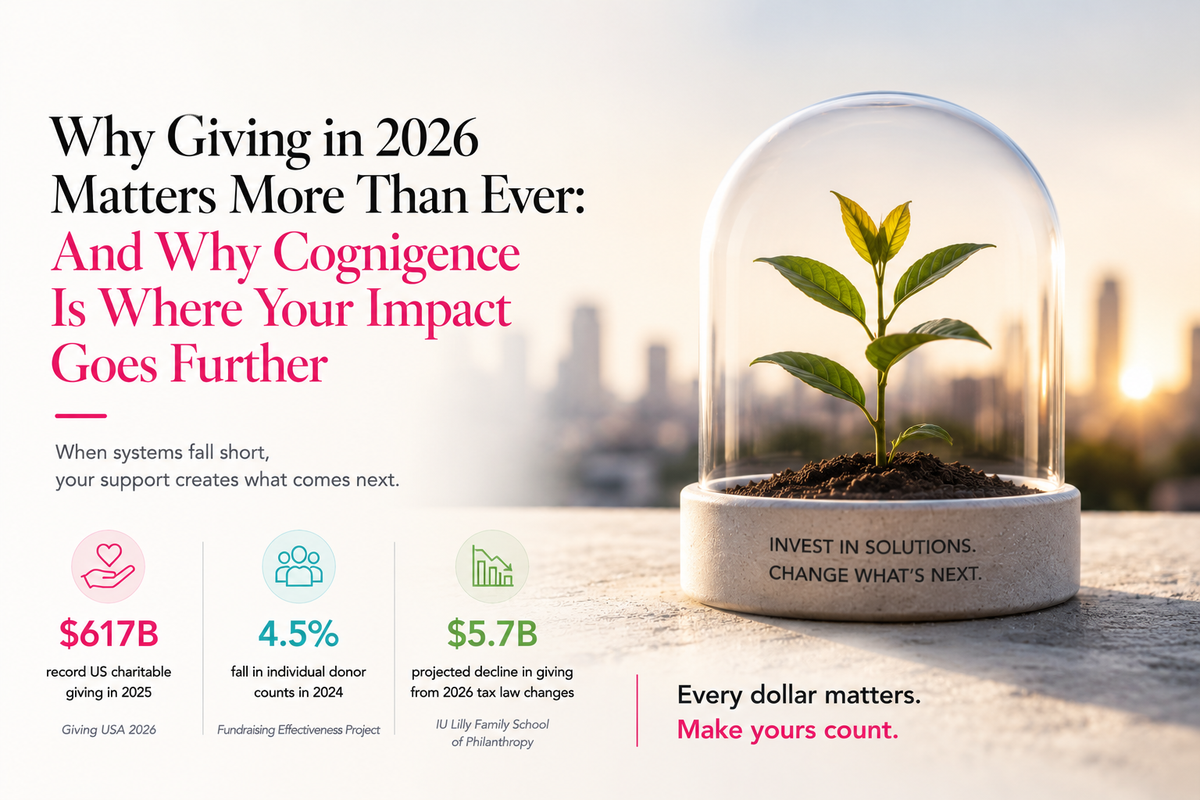
US charitable giving reached a record $617.2 billion in 2025, despite economic uncertainty, policy disruption, and rising costs. According to Giving USA 2026, donors continued to give because they understood something important: when federal funding retreats and systems fail, private philanthropy is not a nice-to-have. It is the last line of defense for the causes that matter most.
But giving more is not the same as giving smarter. In an economy where every dollar is scrutinized, the organizations that earn charitable capital in 2026 will be the ones that can prove, not just claim, that their model works. This blog makes that case for Cognigence.
The 2026 Giving Environment: Why This Moment Is Different
The 2026 giving landscape has two contradictory features. Overall giving is at record levels, $617 billion in 2025. But the number of individual donors is declining. Donor counts fell 4.5% in 2024. Small and mid-level donors are giving less frequently. And the Foundation Source 2026 Giving Outlook notes that "a growing concentration of giving among high-net-worth individuals may be masking a broader disengagement among everyday donors."
Translation: more money is moving through philanthropy, but fewer people are choosing to give, and those who do are being more selective than ever about where their money goes.
At the same time, Armanino's 2026 nonprofit trends analysis documents a policy environment that has created real urgency: federal funding cuts hit nonprofits with little warning in 2025, forcing rapid operational adjustments across the sector. New tax rules, including a 0.5% AGI floor on charitable deductions for itemizers and a cap at 35% of donation value for top earners, mean donors giving in 2026 are working with a more constrained tax benefit than they had before.
In this environment, every donation decision carries more weight. Donors who are giving less frequently but more intentionally want to know three things: Is this organization financially efficient? Will my money produce measurable results? And is there any accountability if it doesn't?
These are exactly the questions Cognigence was built to answer.
7 Reasons to Choose Cognigence, Especially in This Economy
Cognigence vs. the Alternative: What You Actually Get
Why Now Is Exactly the Right Time, Not a Reason to Wait
The temptation in an uncertain economy is to wait for clarity. Wait until markets stabilize. Wait until the policy environment settles. Wait until you have more certainty about your own financial picture.
But the causes Cognigence funds do not wait. Pancreatic cancer doesn't pause while federal budgets are renegotiated. Autoimmune disease doesn't become less devastating because the NCI is cutting staff. Climate change doesn't slow down because the regulatory environment is unstable. The 700 million people in extreme poverty don't have the luxury of waiting for conditions to improve.
And the data reinforces this. Record giving in 2025, $617.2 billion, happened despite every headwind the economy could create. Donors who gave during uncertainty did not regret it. Organizations that maintained donor relationships through difficult periods emerged stronger. The Chronicle of Philanthropy's 2026 forecast puts it simply: "I expect charitable foundations to do what they were made for: give more when times are tough." Individual donors can operate by the same principle, and with Cognigence, they have the tools to ensure every dollar they give in difficult times goes exactly where it is most needed and produces the most measurable good.
Whatever Your Situation, Cognigence Has a Path
If you are giving a smaller amount this year
New tax rules in 2026 include an expanded charitable deduction for non-itemizers, meaning donors who take the standard deduction can now receive a tax benefit for charitable giving. Combined with Cognigence's $0.25 per dollar overhead ratio, even a $250 donation reaches $187.50 worth of direct cause funding, compared to as little as $50–$125 at an average charity. Small gifts go further here.
If you have appreciated assets, stock, crypto, or real estate
Contributing appreciated non-cash assets through a donor-advised fund or directly to Cognigence eliminates capital gains tax and maximizes the fair market value available for impact. In 2025, 63% of DAF contributions were non-cash assets. If you are holding appreciated stock and looking for a tax-efficient giving strategy, Cognigence's 501(c)(3) status makes it an eligible direct recipient, and our blockchain tracking ensures those assets are deployed transparently.
If you are a financial advisor or tax professional
Cognigence provides what your clients increasingly need from charitable giving: SROI documentation, blockchain-verified fund deployment, cause-specific allocation, and an equity gifting model that can be integrated into a broader wealth strategy. We welcome advisor conversations and partnership inquiries at cognigence.org.
If you are a high-net-worth donor navigating new deduction limits
The 2026 deduction cap of 35% for top earners makes efficiency critical. Cognigence's operational model, $0.25 per dollar, maximizes the social value of every dollar within your constrained deduction envelope. And our Harvard SROI reporting gives you the documentation to demonstrate, concretely, what your charitable capital accomplished.
The Bottom Line: In This Economy, Every Dollar Has to Count, Ours Do
There will never be a perfect time to give. There will always be economic uncertainty, tax law changes, policy volatility, and personal financial pressures competing for the same dollars. That has always been true. What is new in 2026 is the scale of the gap between what government can fund and what society needs, and the growing recognition that private philanthropy is not a supplement to that gap. It is the primary mechanism for closing it.
In that environment, the organizations that deserve charitable capital are the ones that treat it with the same discipline donors apply to every other financial decision. Transparent. Efficient. Measurable. Accountable. Designed to produce returns, social and, where possible, financial.
That is what Cognigence is. That is why we built it the way we did. And that is why, especially in this economy, we believe your giving should come here.