Why Smart Donors Are Moving Away From Traditional Giving And What They're Doing Instead
Abstract
Traditional philanthropy is no longer meeting the expectations of modern donors. This article explores the major shift happening across charitable giving in 2026 as donors increasingly move away from opaque, trust-based donation models toward data-driven, impact-focused philanthropy. Drawing on industry research, donor behavior trends, and the rise of impact investing, the analysis examines why today’s donors demand real-time transparency, measurable outcomes, lower operational overhead and active participation in the causes they support. It also outlines the six defining shifts reshaping philanthropy: from verified accountability and cause-specific giving to portfolio-style philanthropy and donor-investor engagement and explains how emerging venture philanthropy models are adapting to this new landscape. Ultimately, the article argues that the future of giving will belong to organizations capable of combining transparency, measurable impact, technology-enabled accountability and long-term donor alignment into a single modern philanthropic framework.
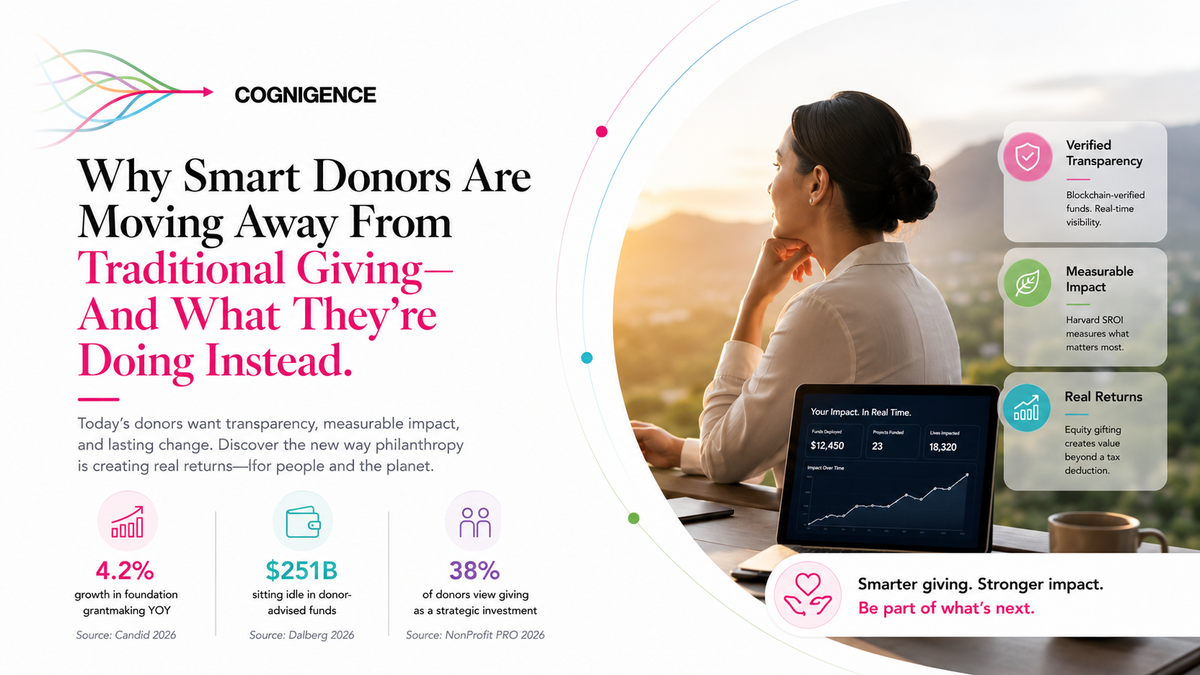
The way people give money to causes they care about is changing faster in 2026 than at any point in the history of organized philanthropy. Not because generosity is declining, it isn't. Candid's 2026 outlook on charitable giving shows grantmaking by private foundations grew 4.2% year-over-year. The stock market is strong, generational wealth transfer is accelerating and high-net-worth donors have more capital available than ever.
The shift isn't in the amount. It's in the expectations attached to it.
Donors in 2026 are not writing checks to legacy charities and hoping for the best. They are asking harder questions: Where exactly does my money go? What does it accomplish? How is that measured? Can I verify it independently? And, increasingly, is there any way for this to generate a return beyond a tax deduction? As NonProfit PRO's 2026 sector analysis puts it: "Many donors today are successful entrepreneurs and they are beginning to view their philanthropic giving the same way they view any strategic investment. They want clarity, visibility and a sense of return."
This is not a niche trend. It is a structural shift in how charitable capital moves and it is the exact reason Cognigence was built the way it was. Venture philanthropy model. Blockchain-verified transactions. Harvard SROI accountability. $0.25 per dollar on operations. An equity gifting model that gives back. In 2026, this isn't ahead of the curve. It's exactly where the curve is going.
The Three Forces Driving the Shift Away From Traditional Giving
Three converging forces are reshaping philanthropy right now. Understanding them explains not just where donor behavior is heading, but why the traditional charity model: write a check, receive a receipt, receive a thank-you tote bag, is structurally failing to meet the moment. MicoCF's 2026 philanthropy trends analysis describes the shift precisely: "What's changing isn't the generosity. It's the strategy."
1. The Expectation Gap: Donors Are Used to Real-Time Accountability
The modern donor tracks their investment portfolio in real time, monitors their carbon footprint through an app and can see exactly where their Amazon return is in the shipping network. Against that backdrop, a charity's annual PDF report, published eight months after the donation was made, using self-reported figures, with no independent verification, is not just inadequate. It is an insult to the donor's intelligence.
According to Foundation Source's 2026 giving outlook, for Gen Z and Millennial donors specifically, "digital innovation is becoming central to trust and engagement." These are not fringe preferences, Gen Z is now the largest US generation and Millennials control a growing share of inherited wealth. Organizations that cannot provide transparent, technology-enabled impact verification are going to lose these donors to ones that can.
2. The Participation Problem: Fewer Donors, Bigger Gifts, Higher Standards
A notable paradox is playing out in 2026: Pledge's giving trends analysis documents that organizations are seeing smaller overall donor pools but higher average gift sizes. Donors are becoming more selective, choosing fewer causes, vetting them more carefully and concentrating larger gifts on the organizations they trust most.
This means the philanthropic marketplace is becoming more competitive, not less. A donor who previously gave $200 to ten charities is now giving $2,000 to one but only after genuinely evaluating whether that organization deserves it. Phīla Engaged Giving's 2026 analysis frames the problem: "Fewer people are giving at all and more money is sitting on the sidelines," $251.5 billion parked in donor-advised funds, stalled by uncertainty about where to deploy it. The organizations that win this environment are the ones that make it easy to trust them.
3. The Return Question: Donors Want More Than a Tax Deduction
Perhaps the most significant attitudinal shift in 2026 philanthropy is the donor-investor mindset, the growing expectation that charitable capital should work like smart capital, generating measurable returns beyond a tax receipt. The Chronicle of Philanthropy's 2026 forecast identifies this directly: "2026 will be the year philanthropists either jump at full speed onto the impact investing train or quietly step off."
The donors who are jumping on are not a niche group. Dalberg's 2026 new generation of giving report documents the rapid growth of collective giving models, pooled impact funds and multi-entity philanthropic structures, all designed to achieve the scale and accountability of institutional investment while retaining the social mission of charitable giving. Next-generation donors "have the opportunity to design their giving to be fit-for-purpose from Day 1," and an increasing number are doing exactly that.
"Donors want clarity, visibility and a sense of return. That return is not financial, but it is still real. They want to see the impact of their gifts, understand how their support moves the mission forward and feel confident their contribution creates measurable change."
NonProfit PRO, 2026
6 Shifts That Define the Smart Donor in 2026
These are not predictions. They are documented behavioral changes, drawn from CAF America's research on US philanthropy trends, the Johnson Center's 2026 nonprofit sector trends report and primary research across the giving sector. They define what separates the donor of 2026 from the donor of 2010 and they map directly to how Cognigence's model is built.
What Smart Donors Are Actually Looking For in 2026
Across all the research, a consistent picture emerges of what separates the organizations winning donor confidence in 2026 from those losing it. Orr Group's 2026 nonprofit fundraising trends analysis puts it plainly: "The nonprofits that succeed in 2026 will be those that adapt with intention. They will diversify revenue, invest in major and planned giving and align their strategies with how donors give today, not how they gave in the past."
What does that actually mean in practice? Smart donors in 2026 are looking for five specific things:
Where Cognigence Fits in the New Philanthropy Landscape
Cognigence was not built to be a better version of the traditional charity model. It was built to be a fundamentally different model, one that was designed from the start for exactly the donor behaviors and expectations that 2026 is accelerating. The venture philanthropy framework Cognigence operates on, curated in our resource library, is the closest existing model to what smart donors in 2026 are demanding: strategic capital deployment, accountability mechanisms, long-term relationships and measurable outcomes.
The Forbes analysis of accelerating impact through innovative venturing, also in Cognigence's curated library, describes the inflection point the sector is reaching: organizations that apply VC discipline to social missions are outperforming legacy charities on every metric donors now care about. Impact per dollar. Transparency of deployment. Speed of capital mobilization. Measurability of outcomes.
At Cognigence, here is exactly what that looks like: six focus areas you choose from, each with specific cause-area funding. Blockchain verification from the moment your donation is received. Harvard SROI reporting that quantifies what your gift accomplished. $0.25 per dollar on operations, not a claim, a blockchain-verifiable fact. And an equity gifting model that gives you the opportunity to participate financially in the success of the investments your donation funds.
"2026 will be the year philanthropists either jump at full speed onto the impact investing train or quietly step off. Individual donors and family-led philanthropies have become impact investing leaders."
— Chronicle of Philanthropy, 2026
Who the New Donors Are And What They Have in Common
The smart donor shifting away from traditional giving in 2026 is not a single profile. Dalberg's research on next-generation giving identifies several distinct groups all converging on the same behavioral shift:
Millennial and Gen Z donors who grew up with real-time data and expect the same transparency from their charitable giving as from their investment apps. They are the most likely to research overhead ratios before giving and to abandon organizations that can't provide verifiable impact data.
Entrepreneur-donors: successful business founders and operators who apply investment thinking to their philanthropy. They want strategic alignment, measurable ROI, accountability mechanisms and a sense that their capital is being deployed with the same discipline they applied to building their own companies.
HNW individuals navigating the $84 trillion generational wealth transfer underway in the US. Many are first-time significant donors, working with financial advisors and tax professionals to integrate charitable giving into their overall wealth strategy. They want options beyond the standard tax deduction, which is exactly what Cognigence's equity gifting model provides.
Tax professionals can explore partnership with Cognigence
Corporate and institutional philanthropists integrating ESG commitments into their giving strategy. They need organizations that can provide audit-ready impact reporting and blockchain-verified fund deployment, exactly the standard Cognigence operates at.
Strategic partners can explore collaboration
The Bottom Line: Traditional Giving Had Its Time. This Is What's Next.
Traditional philanthropy did an enormous amount of good. It built hospitals, funded research, created social safety nets and demonstrated that private generosity can address public problems. Nobody is arguing otherwise.
But the model that made traditional philanthropy effective in the 20th century, opaque fund allocation, reputational accountability, annual reporting, no measurable outcome standard, is not adequate for the challenges of 2026 or the expectations of the donors who will fund solutions to them. The Johnson Center's 2026 philanthropy trends report acknowledges that philanthropy's "familiar structures are falling away" and that "resolving emerging tensions will require robust public engagement, openness from the philanthropic sector and a legal framework that accommodates creativity without sacrificing accountability." That is not a critique. It is a description of an evolution that is already underway.
Cognigence is built for what's next. If you've ever donated to a charity and wondered where your money actually went or if you've held back from giving because you couldn't get a satisfying answer to that question, cognigence.org was built for you. Explore our focus areas, understand how we work and make your first smart donation today