How Impact Investing Could Accelerate the Fight Against Cancer

Share
How Impact Investing Could Accelerate the Fight Against Cancer
Abstract

Cancer research is entering a critical funding crisis at the exact moment scientific breakthroughs are becoming most possible. This article examines how shrinking federal research budgets, collapsing grant approval rates and the growing “Valley of Death” between laboratory discovery and clinical trials are preventing promising cancer innovations from reaching patients. Drawing on funding data, healthcare research trends and impact investing principles, the analysis argues that traditional philanthropy alone is no longer sufficient to sustain high-risk, early-stage oncology research. Instead, venture-style impact investing, through long-term capital deployment, measurable SROI accountability, bridge funding and equity-based investment models, may provide the infrastructure needed to accelerate cancer breakthroughs that government agencies and pharmaceutical markets are increasingly unable or unwilling to fund.

In 2018, Harvard Business Review published a landmark analysis arguing that impact investing was uniquely positioned to accelerate cancer research breakthroughs. The argument: philanthropy funds the questions government and pharma won't, impact investing adds accountability, and the two together can unlock the research pipeline that neither can unlock alone.

That argument was compelling in 2018. In 2026, it is urgent.

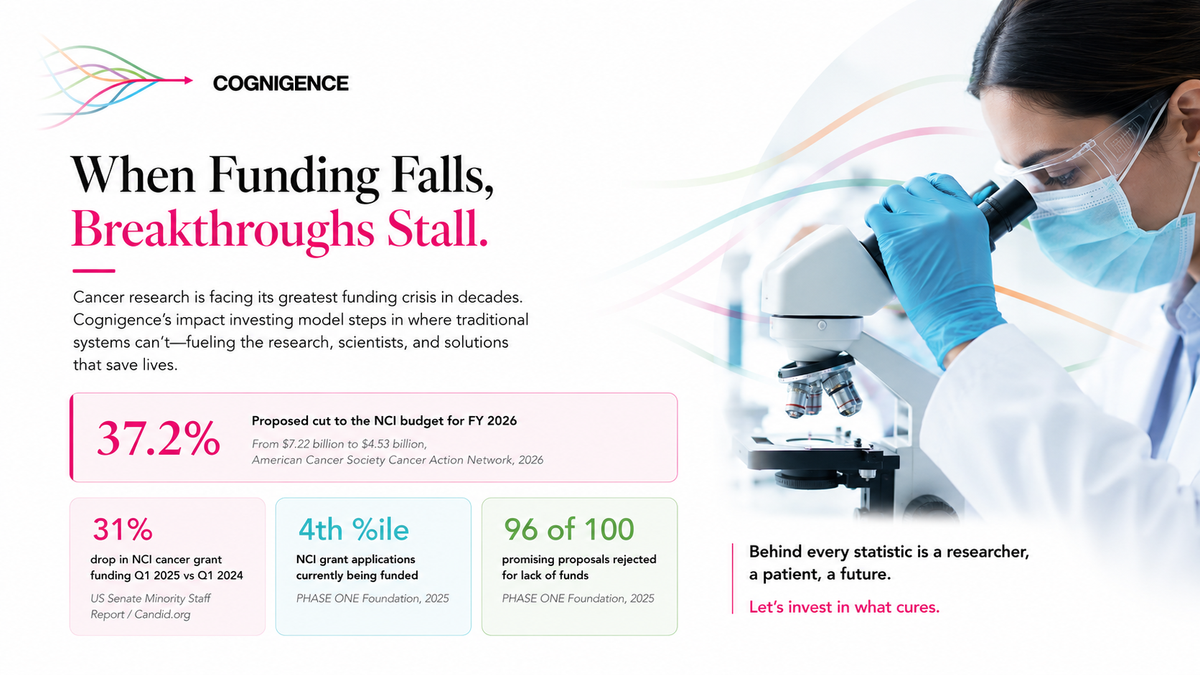
The National Cancer Institute, the world's largest funder of cancer research, faces a proposed budget cut of 37.2% for fiscal year 2026. NCI grant funding already dropped 31% in Q1 2025. The funding rate for new NCI applications has fallen to the fourth percentile, 96 out of every 100 promising proposals rejected for lack of funds. Researchers are losing labs. Clinical trials are stalling. Early-career scientists are leaving cancer research entirely.

Into that vacuum, Cognigence's impact investing model is designed to move.

37.2%

Proposed cut to the NCI budget for FY 2026

From $7.22 billion to $4.53 billion, American Cancer Society Cancer Action Network, 2026

31%

drop in NCI cancer grant funding Q1 2025 vs Q1 2024

US Senate Minority Staff Report / Candid.org

4th %ile

NCI grant applications currently being funded

PHASE ONE Foundation, 2025

18M+

Americans alive today thanks to federally funded cancer research

ASCO Statement, May 2025

The 2026 Cancer Research Funding Crisis: What the Numbers Mean

Candid.org's analysis of cancer research funding cuts describes an ecosystem under simultaneous pressure: direct grant cuts, staff reductions, supply chain disruptions at NCI facilities, and collapse of indirect cost funding at universities.

The American Cancer Society Cancer Action Network puts the stakes clearly: NCI-supported clinical trials between 1980 and 2020 added an estimated 14.2 million life-years to cancer patients. Every dollar of NCI funding withdrawn is a direct reduction in the pipeline that produces those life-years.

The PHASE ONE Foundation's analysis adds a critical concern: early-career cancer researchers are leaving the field because there is no funding to support their work. When that talent leaves, the discoveries they would have made simply don't happen.

As OncLive's 2026 reporting notes, equity-focused research is disproportionately at risk, clinical trials addressing racial and socioeconomic disparities in cancer outcomes are losing support at exactly the moment when those disparities were beginning to receive serious scientific attention.


"There will need to be commensurate increases in foundation support, philanthropy, and industry partnerships. We may need to be more creative about how we conduct trials going forward.", Dr. Daniel Spratt, OncLive 2026

The Valley of Death: The Gap Philanthropy Was Built to Bridge

Even before the 2025–2026 funding cuts, cancer research had a structural problem, the Valley of Death, that the HBR analysis, curated in Cognigence's resource library, identified in 2018 and that has only deepened since.

The Valley of Death is the gap between laboratory discovery and clinical use, between a promising compound in a university lab and the first human trial. This requires funding for IND applications, early-stage trial design, regulatory preparation, and Phase I execution. It is expensive, risky, and commercially uncertain, which means pharma won't fund it, and federal grants were only beginning to address it before the cuts.

The Cancer Research Pipeline, Where Money Flows and Where It Stops

Stage

What Happens

Who Funds It

2026 Status

Discovery

Lab breakthrough, promising compound identified

Academic lab, NCI grant

✅ Funded

Pre-Clinical

Animal trials, safety testing, early efficacy data

NCI / university grants

⚠️ At risk

VALLEY OF DEATH

IND filing, Phase 0/I trial design, regulatory prep

Nobody, this is the gap

❌ Unfunded

Early Clinical

Phase I/II trials, first human testing

Mix of pharma + rare philanthropy

⚠️ Partial

Late Clinical

Phase III, large-scale efficacy trials

Pharma only (if commercially viable)

✅ If profitable

Approval

FDA approval, manufacturing, distribution

Pharma exclusively

✅ If market large enough

This is the specific gap that impact investing, deployed through Cognigence's venture philanthropy model, is designed to address. Bridge grants to carry promising research through the Valley. Seed investments in early-stage cancer biotech. Strategic support for clinical trial design in academic labs whose federal funding has been cut.

Why Impact Investing, Not Just Charitable Donation, Is the Right Mechanism

01

Patient Capital for Long-Horizon Research

Cancer breakthroughs take decades. Annual grant cycles are fundamentally misaligned with that timeline. Impact investing applies the venture capital principle of patient capital, multi-year commitments evaluated on long-horizon milestones, not year-one outputs. Cognigence deploys capital on this same logic.

02

Harvard SROI as Accountability Infrastructure

Most cancer philanthropy cannot tell donors which specific research their money funded or what it accomplished. Cognigence applies the Harvard SROI framework to every grant and investment, quantifying outcomes in dollar terms, publishing results for donors, and using SROI data to direct future capital to its highest-impact use.

03

Equity Gifting: Expanding the Capital Pool

The possibility of financial return makes the pool of available capital substantially larger. Donors who would hesitate at a $10,000 charitable gift will make that commitment as an impact investment when there's a credible possibility of return. Cognigence's equity gifting model implements this directly, when investments succeed, donors share in the upside.

What Cognigence's Cancer Research Capital Actually Funds

When you donate to Cognigence's Cancer focus area, capital is deployed across three specific mechanisms, all targeting the gaps the funding crisis has widened:

Valley of Death Bridge Grants

Grants structured to carry research from laboratory validation through IND filing and Phase I trial design, the projects with the clearest early evidence of impact that cannot access pharma funding because commercial viability is uncertain, and cannot access federal grants because funding rates have collapsed to the fourth percentile.

Early-Stage Oncology Biotech Investment

Direct equity investment in early-stage companies working on underfunded cancer challenges: AI-powered diagnostics for rare cancers, liquid biopsy platforms for early detection in underserved communities, personalized immunotherapy for cancer types with the lowest survival rates. Selected for SROI potential, not commercial scale.

Prevention & Early Detection in Underserved Populations

Targeted grants for prevention and screening in communities where the retreat from equity-focused research has left the greatest gap. Early detection of lung cancer reduces mortality by up to 24%, yet only 18% of eligible patients receive screening. Cognigence deploys capital to close that gap.

Traditional Cancer Charity vs. Cognigence Impact Model

❌  Traditional Cancer Charity

✅  Cognigence Impact Investing Model

Funds awareness campaigns and patient support

Funds early-stage research and Valley of Death bridge grants

$0.50–$0.80 per dollar on operations

Only $0.25 per dollar, blockchain-verified

No visibility into research outcomes

Harvard SROI measures every grant and investment outcome

General fund, donor has no control over use

Donor chooses cancer focus area, allocation tracked on-chain

Tax deduction is the only donor benefit

Equity gifting model, donors share in upside of successful investments

No accountability for whether research advances

SROI reporting shows dollar-denominated value of outcomes

Reactive to funding crises

Proactively targets the Valley of Death and the NCI funding gap

2026 Is the Year Impact Investing in Cancer Research Matters Most

The HBR case for impact investing in cancer research described an opportunity. The 2026 federal funding crisis has converted that opportunity into an obligation. Cognigence's blockchain-verified model, $0.25 per dollar on operations, Harvard SROI accountability, and an equity gifting model that aligns donor and patient interests, is built precisely for this moment.

The research that will save lives in 2035 is being proposed in labs right now, and going unfunded because the grant rate is at the fourth percentile. Your donation through Cognigence is the bridge. See how it works at cognigence.org/learn-more, and choose cancer research as your focus area today →

Fund the Research That Can't Wait for the Government

Cognigence directs your tax-deductible donation to early-stage cancer research, the Valley of Death that federal funding can't reach and pharma won't touch. Blockchain-tracked. Harvard SROI-measured. $0.25 per dollar to operations.

→  Support Cancer Research at cognigence.org/focus

→  Donate with full transparency at cognigence.org/donate

Explore More

Cognigence Pages

→  Focus Areas, Cancer & All Six Causes

→  About Us, Our Mission & Model

→  Learn More, SROI & How It Works

→  Donate, Give With Full Transparency

→  Resources, Thought Leadership Library

→  For Strategic Partners

→  For Tax Professionals

From the Resource Library

→  HBR: Impact Investing & the Fight Against Cancer

→  Fortune: The Diseases We Aren't Curing, And Why

→  McKinsey: A Closer Look at Impact Investing

→  Investopedia: What Factors Go Into Calculating SROI?

→  HBR: Calculating the Value of Impact Investing

→  Forbes: Accelerating Impact Through Innovative Venturing

Read more

Why Economic Inequality Is a Philanthropy Problem and Why Venture Capital Principles Can Fix It

Why Economic Inequality Is a Philanthropy Problem and Why Venture Capital Principles Can Fix It

Abstract Despite nearly $600 billion in annual charitable giving, global economic inequality remains deeply entrenched because traditional philanthropy is largely designed to relieve symptoms rather than fund long-term structural change. This article examines how aid-based giving models often fail due to short funding cycles, weak accountability frameworks, and high operational

By Team Cognigence