Abstract
As global crises become increasingly interconnected, the question facing donors in 2026 is no longer whether to give, but where philanthropic capital can generate the greatest measurable impact. This article examines six of the world’s highest-leverage cause areas, including MedTech, cancer research, diabetes prevention, autoimmune disease research, climate intervention and poverty reduction, through the lenses of scale, neglect and tractability. Drawing on global poverty data, healthcare funding gaps, climate risk research and SROI frameworks, the analysis argues that the most effective giving strategies prioritize underfunded systemic problems where targeted capital can create compounding long-term outcomes. The article further explores how Cognigence’s blockchain-verified venture philanthropy model applies accountability, transparency and measurable impact evaluation to modern charitable giving, transforming donations from passive contributions into strategic investments in global change.
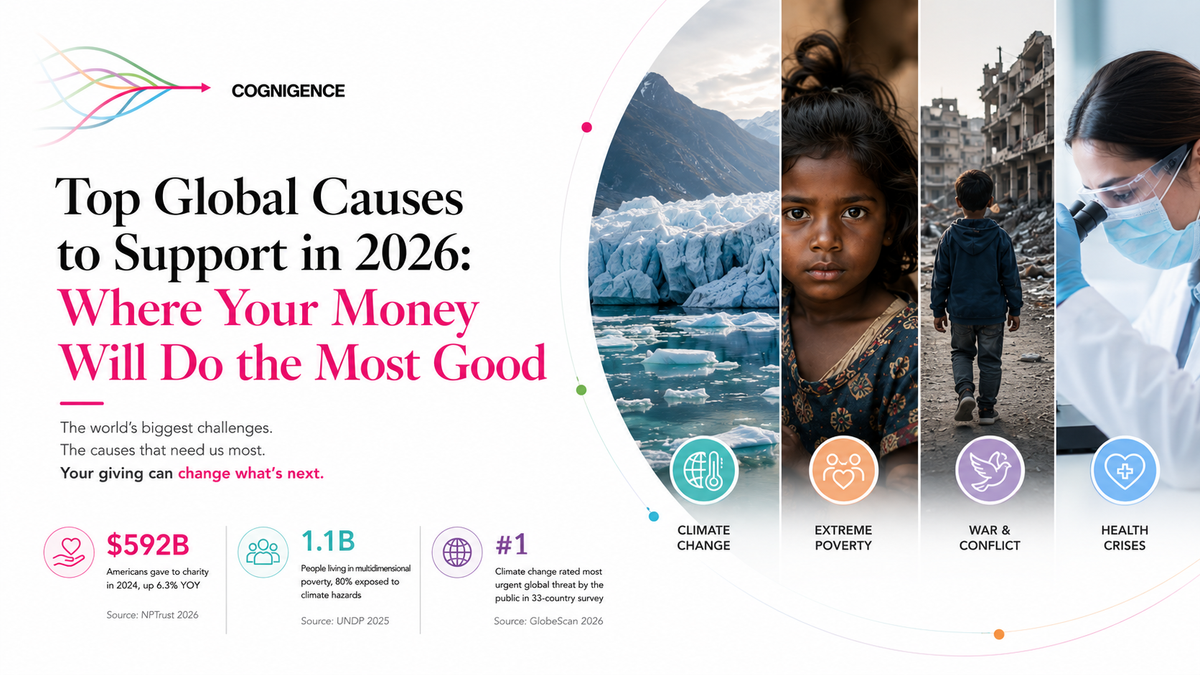
Americans gave $592.5 billion to charitable causes in 2024, a 6.3% increase from the year before. According to NPTrust's 2026 charitable giving statistics, international affairs giving grew 17.7% in a single year, and public-society benefit giving jumped 19.5%. Generosity is not in decline. But the question of where to give, to which causes, through which vehicles, with what expectation of impact, has never been more urgent or more complex.
In 2026, three global challenges have emerged from a 33-market GlobeScan survey as a clear top tier of perceived urgency: climate change, extreme poverty, and war and conflict. They sit apart from every other issue in terms of both seriousness and urgency. And they intersect directly with the health crises, cancer, diabetes, autoimmune disease, that the healthcare system is systematically failing to fund.
$592B Americans gave to charity in 2024, up 6.3% year-over-year Source: NPTrust Charitable Giving Statistics 2026 | 1.1B people living in multidimensional poverty, 80% exposed to climate hazards Source: UNDP Global MPI Report 2025 | #1 Climate change rated most urgent global threat by public in 33-country survey Source: GlobeScan April 2026 |
How to Evaluate a Global Cause Before You Give
Not all giving is equal. The CAF World Giving Report 2025 found that 36% of people globally said they would be more likely to donate if they knew more about how their money would be spent and 35% said they needed to understand the impact their charity might have before giving. Clarity and transparency, CAF concluded, "provide confidence alongside a clear narrative about how the support is helping to change lives."
Before evaluating any specific cause, use these three questions to filter your giving:
1 | Scale How many people are affected? Is the problem growing or shrinking? A cause affecting 500 million people with inadequate current funding has a higher leverage opportunity than one that is well-funded already. |
2 | Neglect Is this cause underfunded relative to its burden? Causes that receive less philanthropic and government attention per person affected offer the greatest marginal return on your donation. |
3 | Tractability Are there proven, scalable solutions that philanthropic capital can fund? The highest-impact giving directs money toward approaches with evidence behind them, not just urgent-sounding problems. |
All six of Cognigence's focus areas score well on all three dimensions. They are large in scale, systematically underfunded relative to their burden, and tractable through the combination of R&D grants, direct investment, and MedTech support that Cognigence's model deploys. Here is the 2026 case for each one.
The Six Most Impactful Causes to Support in 2026
Cause 1: MedTech, Funding the Technology That Expands Healthcare Access $660B+ global digital health market projected by 2028 |
Healthcare technology is one of the highest-leverage cause areas in 2026 and one of the most systematically underfunded by mainstream philanthropy. AI-powered diagnostics, wearable health monitors, telehealth platforms, and point-of-care testing are not science fiction. They exist. The barrier to getting them to the people who need them most, rural populations, Medicaid recipients, low-income countries, is capital, not capability.MedCity News's analysis of VC funding gaps in digital health, curated in Cognigence's resource library, documents exactly why venture capital doesn't go there: Medicaid patients aren't profitable enough. That leaves philanthropic capital as the primary mechanism for funding MedTech that reaches the people who need it most. McKinsey's impact investing analysis shows that early-stage MedTech investments generate some of the highest SROI in the healthcare sector when directed at underserved populations. SROI Opportunity: Early-stage MedTech targeting underserved populations generates exceptional SROI, every dollar funds technology that reaches thousands. Cognigence's blockchain ledger tracks exactly which technologies your donation supports. → Support this cause at Cognigence: cognigence.org/focus |
Cause 2: Cancer Research, Funding the Questions Pharma Won't Ask 2.1M Americans will be diagnosed with cancer in 2026 |
The cancer funding paradox is one of the starkest in global health: $307 billion is spent on cancer R&D globally, yet 55% of that funding concentrates in just four cancer types. Pancreatic cancer, with a 13% five-year survival rate, remains drastically underfunded. Uterine corpus cancer mortality has risen for 26 consecutive years. The NCI faces a proposed 37% budget cut in 2026.HBR's analysis of impact investing in cancer, one of Cognigence's curated resources, makes the case directly: philanthropic capital is the only mechanism capable of funding the high-risk, non-commercial cancer research questions that could generate the greatest breakthroughs. De-escalation research. Rare cancer diagnostics. Prevention programs in underserved communities. These are the gaps your donation fills. SROI Opportunity: Cancer research philanthropy targets the highest-burden, lowest-funded gap in the entire healthcare system. The SROI of rare cancer diagnostics and prevention research is extraordinarily high and essentially impossible to fund any other way. → Support this cause at Cognigence: cognigence.org/focus |
Cause 3: Diabetes Prevention, Fixing the Problem Before It Becomes a Crisis 537M people living with diabetes globally, projected 643M by 2030 |
Diabetes is one of the most economically devastating chronic diseases in history and one of the most preventable. The healthcare system invests almost entirely in treatment (because treatment drugs generate recurring revenue) and almost nothing in prevention (because prevention doesn't). This is a market failure with a straightforward philanthropic solution.The WHO's diabetes fact sheet, curated in Cognigence's resource library, documents the staggering global burden: 1.5 million deaths annually, exploding prevalence across low- and middle-income countries, and healthcare systems ill-equipped to absorb the coming wave. The social return on investment for diabetes prevention is among the highest of any healthcare intervention, every dollar spent preventing diabetes avoids dramatically greater downstream treatment costs. Philanthropic capital that funds prevention programs and early-intervention MedTech is producing measurable results that the healthcare market structurally cannot deliver. SROI Opportunity: Diabetes prevention generates some of the highest-SROI health investments available. Preventing one case of Type 2 diabetes avoids an average of $10,000–$15,000 in annual treatment costs, for a lifetime. Cognigence measures this return using Harvard SROI. → Support this cause at Cognigence: cognigence.org/focus |
Cause 4: Autoimmune Disease Research, Addressing the $100B Crisis Nobody Talks About 50M+ Americans living with an autoimmune condition, rising every year |
Autoimmune diseases are among the most underfunded major health crises in the world. They affect more than 50 million Americans, cost the US economy over $100 billion annually, and take an average of 4.5 years to diagnose. The NIH's own 2026–2030 Strategic Plan for Autoimmune Disease Research explicitly acknowledges the chronic underfunding of this field.HCPLive's reporting on the $100B+ annual autoimmune cost, curated in Cognigence's resource library, puts the scale of the problem in stark terms. And yet autoimmune conditions receive a fraction of the research funding allocated to cancer or cardiovascular disease. The 2026 autoimmune funding landscape is beginning to shift, with new venture philanthropy models specifically targeting this gap, but the capital requirement far exceeds what has been mobilized. Cognigence's autoimmune focus area funds early-stage diagnostics, biomarker research, and treatment protocols for the conditions NIH acknowledges need urgent attention. SROI Opportunity: Autoimmune research is one of the most capital-starved focus areas in health philanthropy. The gap between disease burden and research investment is wider here than almost anywhere else, making each philanthropic dollar exceptionally high-leverage. → Support this cause at Cognigence: cognigence.org/focus |
Cause 5: Green Earth, The Highest-Leverage Climate Investment Available to Individuals 887M people in poverty directly exposed to climate hazards, 80% of all extreme poor |
Climate change is not just an environmental issue in 2026. It is the defining poverty amplifier of our era. The UNDP's 2025 Global Multidimensional Poverty Index report found that nearly 8 in 10 people living in multidimensional poverty, 887 million people, are directly exposed to climate hazards: extreme heat, flooding, drought, air pollution. Nature Climate Change's 2026 research confirms that a 1°C increase in temperature causes headcount poverty increases of up to 1.18 percentage points, pushing tens of millions of additional people below the poverty line.The World Bank estimates that climate's health effects alone could drive 44 million people into extreme poverty by 2030. The scale of this problem and the urgency of the SROI case for early climate intervention, makes Green Earth one of the highest-leverage philanthropic investments available to individual donors in 2026. Cognigence's Green Earth focus funds clean energy access, carbon technology, and environmental justice initiatives with blockchain-verified impact reporting. SROI Opportunity: Climate philanthropy generates some of the highest measured SROI available, each dollar invested in prevention avoids many multiples in downstream poverty, health, and displacement costs. Carbon abated per dollar is measurable, verifiable, and compounding. → Support this cause at Cognigence: cognigence.org/focus |
Cause 6: Underprivileged Communities, Breaking the Poverty Cycle at Its Root 700M+ people living in extreme poverty, less than $2.15 per day |
Extreme poverty is not just a lack of money. It is the compounding of every other crisis on this list: no access to healthcare, no protection from climate shocks, no path to entrepreneurship or economic mobility. FINCA's world poverty statistics, in Cognigence's resource library, document the staggering scale: over 700 million people living on less than $2.15 a day, concentrated in Sub-Saharan Africa and South Asia, in communities with the least infrastructure to respond to health or climate shocks.The World Bank's research on why economic inequality matters for development, also in Cognigence's curated library, makes the systemic case: inequality is not just a moral problem, it is an economic development brake that affects every other outcome. Cognigence's Underprivileged focus area funds entrepreneurial education, community health infrastructure, and economic empowerment programs that attack the root causes of extreme poverty, not just its symptoms. Harvard SROI analysis of education and entrepreneurship programs consistently shows some of the highest long-term social returns of any philanthropic investment. SROI Opportunity: Entrepreneurial education and economic empowerment programs in underserved communities have measured SROI of $3–$8 for every dollar invested over a 10-year horizon, making this one of the highest long-term return cause areas in the Cognigence portfolio. → Support this cause at Cognigence: cognigence.org/focus |
How to Choose the Right Cause for You
The six causes above are not competing priorities. They are deeply interconnected: climate change drives poverty, poverty limits healthcare access, healthcare gaps compound disease burden, disease burden drives economic inequality. Charity.org's global giving guide describes this interconnection well: "With global economies increasingly interconnected, a donation to global causes reverberates in communities across the world."
The most effective giving in 2026 is not necessarily the giving that targets the largest problem, it's the giving that targets the largest problem relative to existing funding, in a cause area where your specific donation creates measurable change. That is the entire logic behind Cognigence's focus area system.
The world's most urgent problems are not underfunded because people don't care. Americans gave $592.5 billion in 2024. The world gives more every year. The problem is that most of that giving flows through organizations with opaque overhead structures, no independent impact verification, and no mechanism to connect donors to the specific outcomes their money funds.
Cognigence was built to change that, starting with the six cause areas where the gap between funding and need is largest and the SROI opportunity is greatest. Every donation is tracked on blockchain. Every outcome is measured by Harvard SROI. Only $0.25 per dollar goes to operations. And an equity gifting model means that when Cognigence's investments succeed, donors share in the upside.
Your donation to any of these six causes does not disappear into a general fund. It goes to a specific channel, verified on-chain, measured for impact, and reported back to you. Choose your cause at cognigence.org/focus and make 2026 the year your giving actually gives back.
Explore More on cognigence.org