Why Economic Inequality Is a Philanthropy Problem and Why Venture Capital Principles Can Fix It
Abstract
Despite nearly $600 billion in annual charitable giving, global economic inequality remains deeply entrenched because traditional philanthropy is largely designed to relieve symptoms rather than fund long-term structural change. This article examines how aid-based giving models often fail due to short funding cycles, weak accountability frameworks, and high operational overhead, while arguing that venture capital principles, including long-term investment horizons, measurable SROI frameworks, and strategic reinvestment, offer a more effective path toward sustainable socioeconomic mobility. Through healthcare, entrepreneurial education, and community infrastructure investment, Cognigence’s venture philanthropy model demonstrates how blockchain transparency and outcome-driven capital deployment can transform charitable giving from transactional relief into measurable systemic change.
The Problem
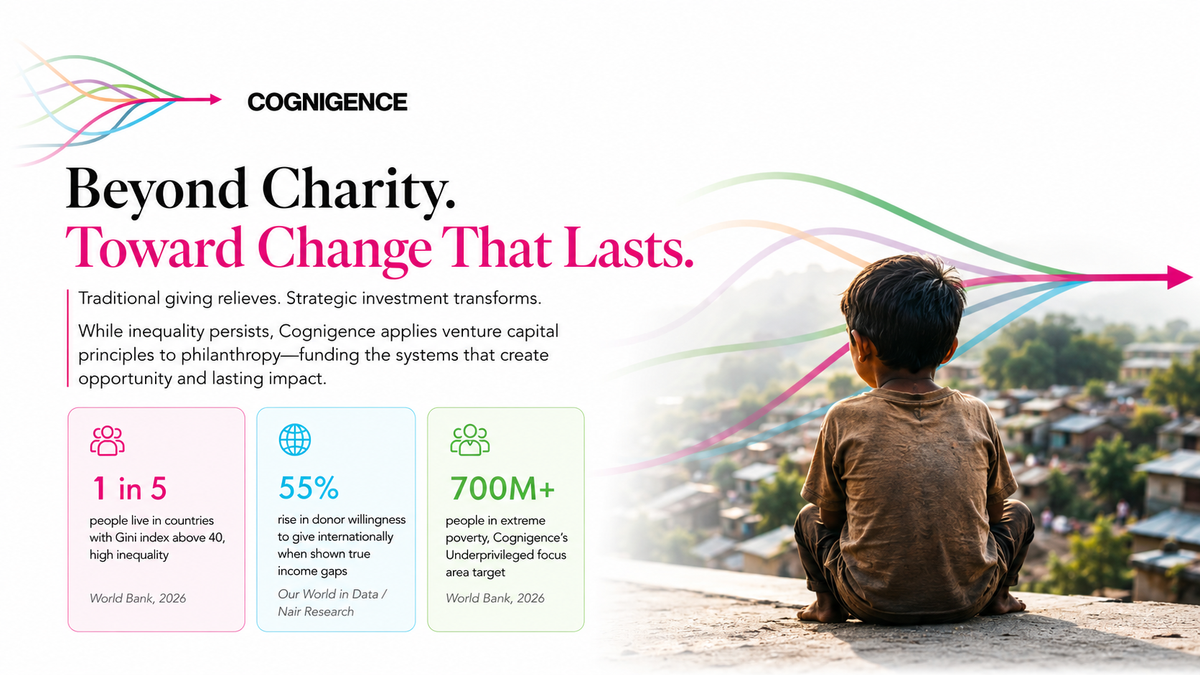
Here is what $592.5 billion in annual US charitable giving has not been able to solve: approximately one-fifth of the world's population still lives in countries with high inequality. Progress in reducing the Global Prosperity Gap has stalled since the pandemic. The World Inequality Report 2026, compiled by over 200 researchers, opens with a stark conclusion: "Inequality persists at a very extreme level."
None of this is for lack of generosity. The problem is strategy. Traditional charitable giving is not built to address root causes. Venture capital principles applied to philanthropy are. This is the core logic behind Cognigence's approach to economic inequality: systemic investment in the mechanisms of upward mobility, not just relief from its absence.
Why Half a Trillion Dollars a Year Isn't Fixing Economic Inequality
The World Bank's research on why inequality matters for development is direct: high economic inequality limits socioeconomic mobility, slows broad-based growth, entrenches poverty, and deepens inequality further. It is a self-reinforcing cycle. Breaking it requires sustained, strategic investment, not a one-time donation.
Traditional philanthropic giving is structurally oriented toward symptomatic relief: food banks, emergency shelter, single-year grants. These relieve immediate suffering, but leave the conditions that produce it unchanged. When donors repeat the same gift year after year without seeing structural change, many conclude the problem is intractable. In fact, capital is simply being deployed the wrong way.
As the World Inequality Report 2026 states: "Inequality is not inevitable. It is shaped by choices, institutions, and power." If inequality is shaped by choices, it can be changed by better ones, funded by philanthropic capital deployed with strategic discipline.
Four Ways Aid-Based Philanthropy Fails to Address Root Causes
When donors learn the true scale of global income disparity, their willingness to give internationally rises by 55%. The issue is not motivation, it is mechanism. Here is where the traditional model breaks down:
How Venture Capital Principles Change the Equation
Venture capital's discipline, rigorous evaluation of potential impact, long-term investment horizons, accountability to measurable outcomes, and expectation of return, is exactly what philanthropic capital targeting inequality has been missing. Applied here, venture philanthropy unlocks four capabilities traditional aid-based giving cannot provide:
Where Economic Inequality Is Most Concentrated in 2026
The Healthcare-Poverty Link
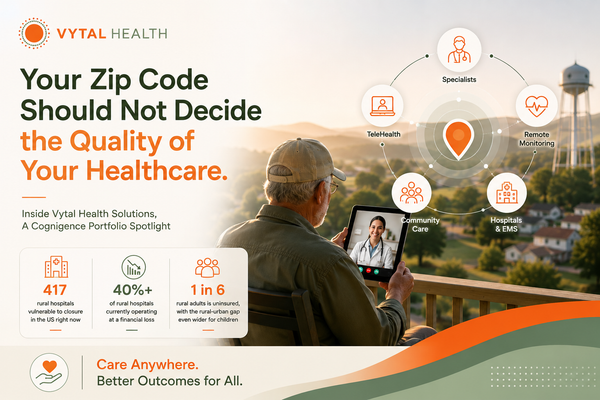
Health shocks push approximately 100 million people into poverty every year. Diabetes, autoimmune disease, and cancer are not just health problems, they are poverty-producing mechanisms for households that cannot absorb treatment costs. Funding medical research in high-inequality contexts generates SROI substantially higher than the same research in wealthy, well-insured populations, because the downstream poverty-prevention value compounds on top of the direct health value.
The Entrepreneurial Education Gap
Teaching business skills, financial literacy, and entrepreneurial thinking in underserved communities creates compounding returns. A person who builds a business does not just escape poverty, they create employment, invest in their community, and model possibility for the next generation. The SROI of entrepreneurial education, measured over a 10-year horizon, consistently exceeds direct resource provision by a factor of three to eight.
The Scale of the Problem
Over 700 million people live in extreme poverty on less than $2.15 a day, concentrated in Sub-Saharan Africa and South Asia, regions with the weakest healthcare infrastructure, lowest educational attainment, and greatest climate vulnerability. Inequality compounds across every dimension simultaneously. Breaking the cycle requires capital deployed at the intersection of health, education, and economic empowerment, exactly what Cognigence's Underprivileged focus area funds.
How Cognigence Applies Venture Principles to Economic Inequality
Cognigence's Underprivileged focus area funds the upstream determinants of economic mobility: education programs with measurable employment outcomes, community health infrastructure that prevents the health shocks that drive families into poverty, and entrepreneurial development programs with SROI-measured business creation rates.
Every dollar is tracked on blockchain from donation to deployment. Only $0.25 per dollar goes to operations, compared to the $0.50–$0.80 industry average. Harvard SROI methodology is applied to every program, ensuring the investments producing the highest social return per dollar are prioritized and scaled. Your donation is not a leap of faith. It is a verifiable, measured, accountable investment in structural change.
Aid-Based Philanthropy vs. Cognigence Venture Model
The Bottom Line: From Transactional Giving to Systemic Investment
If you are already giving to causes connected to economic inequality, poverty relief, education, healthcare access, the question is not 'am I giving enough?' but 'is my giving producing structural change?'
At Cognigence, your donation to the Underprivileged focus area funds programs with documented SROI, blockchain-verified deployment, and a long-term investment horizon. Every dollar tracked. Every outcome measured. $0.25 per dollar to operations. The rest funds the structural change that 700 million people are waiting for.