Why Cognigence Chose to Invest in Cancer Research: The Case for Funding the Gaps Big Pharma Won't Touch
Abstract
Despite unprecedented advances in oncology, large segments of cancer research remain critically underfunded because pharmaceutical investment is concentrated primarily on commercially profitable cancer types and treatments. This article examines the structural gaps within modern cancer funding, including the neglect of rare cancers, prevention research, early-detection technologies and underserved patient populations, as federal research budgets continue to contract and industry funding becomes increasingly market-driven. Drawing on cancer funding trends, clinical trial disparities and healthcare investment data, the analysis argues that philanthropic capital has become essential for supporting high-risk, early-stage, and non-commercial cancer research that traditional funding systems systematically overlook. The article further explores how Cognigence applies a venture philanthropy framework, combining blockchain transparency, Harvard SROI accountability, and strategic MedTech investment, to direct capital toward neglected oncology research areas capable of generating substantial long-term social and medical impact.
In 2026, an estimated 2.1 million Americans will be diagnosed with cancer. That's roughly 5,800 new cases every single day. And yet, the majority of cancer research dollars, the billions flowing from pharmaceutical companies into clinical trials, are concentrated in just a handful of cancer types, chasing the biggest markets, not the biggest needs.
The gaps left behind are enormous. Rare cancers. Prevention research. Early-detection technology for underserved communities. These are the places where philanthropic capital doesn't just help, it's the only capital that will go there at all.
This is why Cognigence, a venture philanthropy nonprofit operating on blockchain technology, chose cancer research as one of its core focus areas. Not because it's easy. Because it's necessary and because the standard model of cancer funding is systematically failing millions of patients.
The Billion-Dollar Blind Spot: Where Pharma Invests and Where It Doesn't
Let's be direct about how cancer funding actually works.
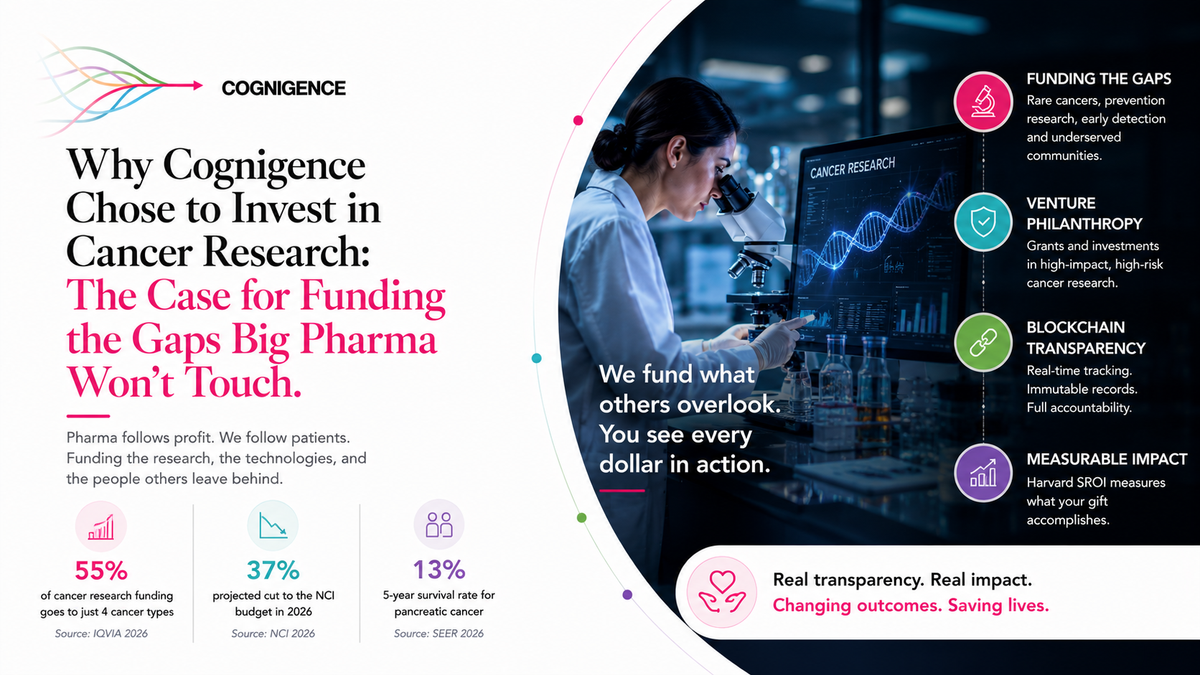
By 2026, an estimated $307 billion will be spent on cancer drug research and development worldwide. That sounds like more than enough. It isn't. Because 55% of that money flows into just four cancer types: breast, lung, prostate and multiple myeloma. Not because those are the only cancers killing people. Because those are the largest markets.
Pharmaceutical companies are not charities. They are publicly traded companies accountable to shareholders. Their R&D decisions are driven by market size, patent windows and regulatory approval probabilities; not by burden of disease or equity of access. Industry-sponsored trials now enroll over eight times more patients than federally sponsored research. For adult studies, that ratio is closer to ten-to-one.
Pharma-sponsored research is mostly geared toward new drug approvals. Federally-funded trials address a broader set of research questions, trials that combine different treatment modalities, de-escalation trials, trials important for patients but low priority for industry.
That quote isn't from a nonprofit activist. It's from a health services researcher at Fred Hutchinson Cancer Center, published in the Journal of Clinical Oncology.
The implications are stark. De-escalation research, figuring out when patients can safely receive less treatment and avoid devastating side effects, gets almost no pharma funding. Multi-modal trials combining surgery, systemic therapy, and immunotherapy sit in funding dead zones. Prevention and early-detection research in low-income communities? Effectively invisible to industry.
The Federal Retreat: A Crisis Philanthropy Must Help Fill
The problem deepened significantly starting in 2025. Federal funding for cancer research was cut by 31% in the first quarter of 2025 compared to 2024. The National Cancer Institute, historically the world's largest source of cancer research funding, lost over $300 million and hundreds of staff members in just three months.
In a projected 2026 federal budget, the NCI faces a potential cut of nearly $2.7 billion: a 37% reduction. If that materializes, entire pipelines of early-stage cancer research will go dark. Clinical trials will be discontinued. Researchers will lose funding mid-project. Promising therapies will stall in the "valley of death," the gap between laboratory discovery and clinical use that has historically been where most cancer breakthroughs die.
37%: Projected cut to the NCI's budget in 2026
National Cancer Institute, the world's largest cancer research funder
Private philanthropy cannot fully replace federal funding. Nobody credible is claiming otherwise. But it can do something federal funding and pharma cannot: move fast, take risks, and fund the questions nobody else will ask. That is precisely where Cognigence operates.
What Gets Missed: The Human Cost of Funding Gaps
Let's make this concrete with two cancers that illustrate the problem perfectly.
Pancreatic Cancer
Pancreatic cancer has a five-year survival rate of 13%. That number has barely moved in decades. Why? Because the tumor microenvironment is extraordinarily hostile to most existing therapies, and the commercial incentive to crack it, given the relatively smaller patient population compared to breast or lung cancer, has never been strong enough for big pharma to prioritize.
Only 17% of pancreatic cancers are caught at the localized stage, where treatment is most effective. Most are diagnosed late. Better early-detection research could save tens of thousands of lives annually but it requires long-term investment in diagnostics and community screening programs that have no near-term commercial payoff.
Rare Cancers and Underrepresented Communities
There are over 200 distinct cancer types. Pharma invests heavily in four. The rest including rare pediatric cancers, cancers disproportionately affecting communities of color, and cancers common in lower-income countries, receive a fraction of available research dollars.
Three times more Black participants were enrolled in federally-supported cancer research than in industry-funded research between 2008 and 2018. As federal funding shrinks and industry dominance grows, that disparity is likely to widen, unless philanthropic organizations deliberately direct capital toward it.
Why Venture Philanthropy Is the Right Model for Cancer Research
Traditional charitable giving to cancer research often follows a familiar pattern: donate to a large foundation, receive a tax receipt, hope for the best. Donors rarely know which specific research their money funds, whether that research succeeded or failed, or what their contribution actually accomplished.
Cognigence was built to change that, starting with a fundamentally different operating model.
How Cognigence Deploys Capital in Cancer Research
Cognigence's approach to cancer funding is built on three levers, the same methodology drawn from venture and private equity investing, applied to social good.
1. R&D Grants for Early-Stage Research
Cognigence funds grants specifically targeting the research questions that fall outside pharma's commercial interest: prevention technology, early-detection diagnostics for underserved populations, and rare cancer treatment modalities. These are grants, not loans, there's no expectation of commercial return. But they are evaluated rigorously using the Harvard SROI scale to ensure every dollar produces measurable impact.
2. Direct Investment in MedTech and Cancer Biotech
Beyond grants, Cognigence takes direct and indirect equity positions in early-stage companies working at the intersection of technology and oncology, AI diagnostics, liquid biopsy platforms, personalized immunotherapy protocols. These investments are chosen for their potential to address gaps in the standard of care, not simply because they're commercially attractive. When these investments succeed, a portion of the equity upside is gifted back to donors.
3. Blockchain-Verified Donor Transparency
Unlike any traditional cancer charity, Cognigence operates on blockchain technology. Every donation is tracked from the moment it lands in Cognigence's systems to the moment it reaches the research it funds. Donors see exactly where their money went, what it funded and, through SROI reporting, what it accomplished. There are no hidden overhead siphons, no opaque foundation accounts. The ledger is public and immutable.
At Cognigence, only $0.25 of every dollar goes to operations. The rest, $0.75, goes directly to the causes you choose. The US nonprofit average is $0.50 to $0.80 spent on overhead before a single dollar reaches a patient.
The SROI Standard: Measuring What Your Donation Actually Does
The Harvard Social Return on Investment framework is the gold standard for measuring social impact. It works by assigning financial values to social outcomes, what did this research prevent? What lives were extended? What medical costs were avoided? and comparing that total value against the investment required to produce it.
Most charities do not use it. It's rigorous, demanding and it holds organizations accountable in ways that make vague impact claims impossible.
Cognigence uses it as standard practice. For every cancer research grant and investment, SROI analysis is conducted and shared with donors. A donor contributing $1,000 to cancer research through Cognigence won't just receive a thank-you email. They'll receive a report explaining the measurable social value their gift generated; in concrete, dollar-denominated terms.
This is what it means to treat donors as partners rather than revenue sources.
Cancer Research in 2026: The Moment for Philanthropic Capital
Here is where we are: cancer immunotherapy is producing genuinely remarkable results for some patients and some cancer types. Survival rates for certain advanced cancers have improved dramatically. The science is working.
But pancreatic cancer survival remains at 13%. Uterine corpus cancer mortality has risen for 26 consecutive years. Early-detection screening for lung cancer, which could reduce mortality by up to 24%, is received by only 18% of eligible patients. The breakthroughs are real. The gaps are also real.
Federal funding is retreating. Pharma investment is concentrating. The window for philanthropic capital to matter, to fund the questions no one else will fund, to back the researchers working on the cancers no one else will touch, is wide open.
Cognigence was built for exactly this moment. A new nonprofit operating with the discipline of a venture fund, the transparency of blockchain, and the singular purpose of directing capital toward the places where it will save the most lives.
What You Can Do
If you've ever written a check to a cancer charity and wondered where it actually went, this is the alternative.
- Choose cancer research as your focus area at cognigence.org
- Your donation is tracked on blockchain from day one, you will see exactly where it goes
- Cognigence applies only $0.25 per dollar to operations, far below the US nonprofit average
- Harvard SROI reporting shows you the measured social value your gift created
- Our equity gifting model means successful investments create an opportunity for financial return, in addition to your tax deduction
Ready to Fund the Gaps Big Pharma Won't?
Cognigence directs your tax-deductible donation to early-stage cancer research using the Harvard SROI framework, so you know exactly what your gift accomplishes. Every dollar is tracked on blockchain. Only $0.25 goes to operations. The rest funds the science.
→ Donate to Cancer Research at cognigence.org/donate
Cognigence Charity, Inc is a 501(c)(3) charitable organization. Your contribution is tax-deductible to the extent allowed by law for income, gift, and estate taxes.