The Diseases We Aren't Curing And Why Philanthropic Capital Is the Answer

Abstract
Despite decades of scientific advancement, the majority of global disease burden continues to receive only a fraction of worldwide medical research funding due to market-driven pharmaceutical incentives and shrinking public research budgets. This article examines the widening “10/90 gap” in global healthcare, where diseases affecting billions of people, including autoimmune disorders, neglected tropical diseases, diabetes prevention, women’s health conditions, and rare cancers, remain chronically underfunded because they offer limited commercial profitability. Drawing on global health research data, NIH funding trends, and pharmaceutical industry analysis, the article argues that philanthropic capital has become one of the few viable mechanisms capable of funding high-impact, low-profit medical research at scale. It further explores how venture philanthropy models, combining blockchain transparency, Harvard SROI accountability, and strategic capital deployment, can redirect funding toward neglected diseases and underserved populations that traditional healthcare systems and commercial markets systematically overlook.
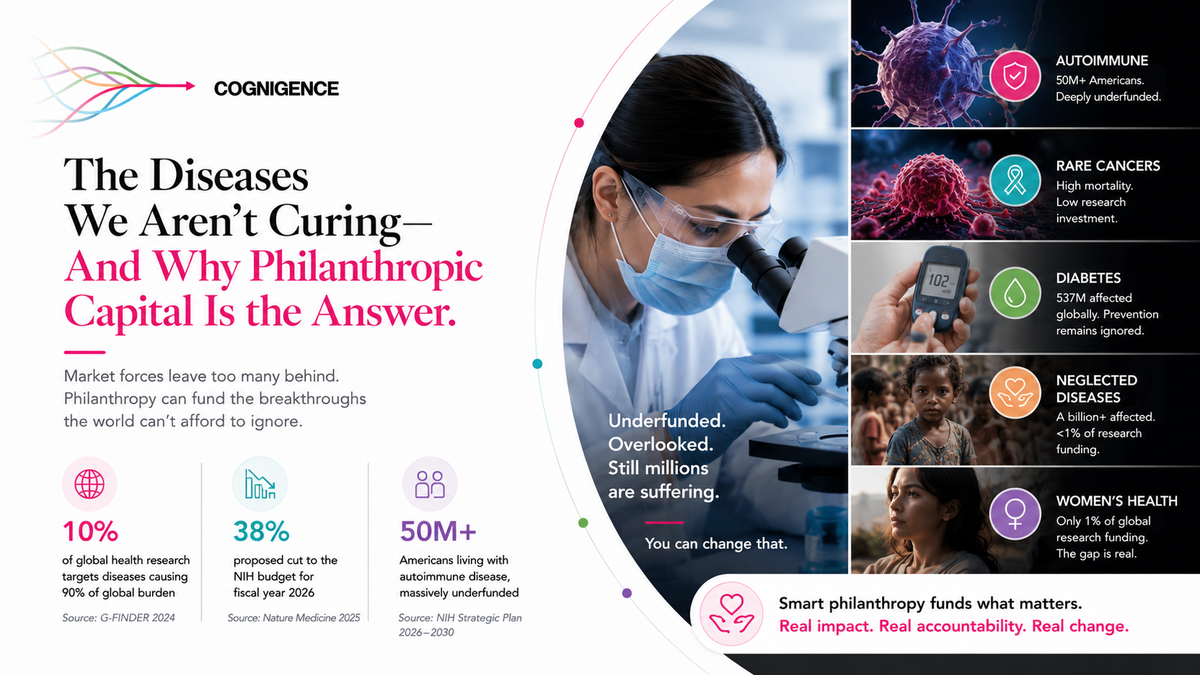
There is a number that the global health establishment has known for decades and done very little about: less than 10% of global health research spending goes to diseases that cause 90% of the world's disease burden.
Read that again. Nine out of every ten dollars in medical research is chasing the same narrow set of conditions, the ones with the biggest commercial markets, the wealthiest patient populations, and the most profitable patent windows. The rest of the world's suffering is, for the most part, a research afterthought. This is not a recent failure. It has a name: the 10/90 gap. And in 2026, with federal research budgets being slashed and pharmaceutical companies doubling down on blockbuster drugs, it is getting worse.
The diseases that don't get cured are not obscure edge cases. They include autoimmune conditions affecting 50 million Americans. Rare cancers with single-digit survival rates. Tropical diseases that kill millions every year in countries pharma doesn't consider worth the investment. Diabetes prevention programs that could save trillions in healthcare costs but generate no revenue for drug companies. Poverty-linked illnesses that devastate entire generations but offer no commercial upside.
This is the gap philanthropic capital was built to fill. And it is the gap that Cognigence, a blockchain-native venture philanthropy nonprofit, exists to fund.
The 10/90 Gap: How the Global Disease Research System Is Broken
The term "10/90 gap" was coined by the Global Forum for Health Research to describe a simple, devastating imbalance: the vast majority of the world's disease burden receives a tiny fraction of research investment, while a handful of profitable diseases receive most of it.
Why does this happen? Because pharmaceutical companies are accountable to shareholders, not patients. Their R&D decisions follow a logic of market size and patent profitability, not burden of disease, not equity of access, not unmet medical need. The private sector invests almost exclusively in drugs for the developed world that will be marketable and profitable. When a disease primarily affects poor countries, rural populations, or people without insurance coverage, it becomes invisible to the industry's investment calculus, regardless of how many lives are at stake.
The consequences of this are not abstract. Nature Medicine's 2025 analysis of two decades of global disease burden data found that research and disease burden have become increasingly misaligned over time and that without intentional intervention, the research-disease divergence will widen by a third over the next two decades. The recent withdrawal of US public funding for international research will accelerate that divergence substantially.
At the same time, ZS's 2026 pharma industry outlook documents deep workforce and budget cuts across the FDA, NIH, and other federal agencies, constraining early-stage research capacity at exactly the moment it needs to expand. The system is moving in the wrong direction, fast. And the only capital that moves in the opposite direction, toward neglected disease, toward underserved populations, toward high-need low-profit research, is philanthropic capital.
The Diseases Being Left Behind: A 2026 Snapshot
Let's make this concrete. These are not statistics in a research paper. These are conditions affecting hundreds of millions of people right now, conditions where the funding gap is causing real, preventable deaths and suffering. They map directly to Cognigence's six focus areas.
Autoimmune Diseases
$100B+
Autoimmune
Autoimmune diseases cost the US economy more than $100 billion annually and yet the NIH's own 2026–2030 Strategic Plan acknowledges that autoimmune research has been "significantly underfunded relative to the high and increasing prevalence" of these conditions. There are over 100 distinct autoimmune conditions. Average time to diagnosis: 4.5 years. The NIH has now recognized the crisis but recognition is not funding.
The scale of the problem is staggering. The NIH's inaugural Strategic Plan for Autoimmune Disease Research (FY 2026–2030) explicitly acknowledges that "major gaps persist in understanding disease mechanisms, risk stratification, early detection, and development of curative therapies" and that most research has been directed toward individual organ-specific manifestations rather than addressing the broader phenomenon of autoimmunity itself. That means the fundamental biology of why the immune system turns on the body remains poorly understood, decades after these conditions were first identified.
The venture philanthropy sector is beginning to respond. Lupus Ventures, a newly formed fund combining life sciences VC discipline with mission-first investing, is specifically designed to close the early-stage funding gap that has stalled autoimmune breakthroughs. The Arthritis National Research Foundation reports that more scientists applied for autoimmune disease research funding in 2026 than at any point in its 50-year history, proof that the research talent is there. The bottleneck is capital. This is precisely why Cognigence's Autoimmune focus area funds early-stage research that the NIH underfunds and pharma ignores.
Diabetes Prevention
537M
Diabetes
537 million people worldwide live with diabetes and the WHO projects that number will reach 643 million by 2030. The vast majority of Type 2 diabetes cases are preventable. Yet the healthcare system invests almost entirely in treatment, not prevention, because treatment generates recurring pharmaceutical revenue and prevention does not. The entire prevention opportunity sits in a funding dead zone.
The economics of this failure are brutal. The WHO's diabetes fact sheet, curated in Cognigence's resource library, documents a disease that kills 1.5 million people annually and generates catastrophic healthcare costs globally. The social return on investment for diabetes prevention is extraordinarily high: every dollar spent on prevention avoids far greater downstream treatment costs, lost productivity, and human suffering. But because prevention doesn't generate patentable drug revenue, it receives a fraction of available research funding. Philanthropic capital, deployed through a rigorous SROI framework, is one of the only mechanisms capable of funding prevention at meaningful scale.
Rare Cancers and Overlooked Tumor Types
55%
Cancer
55% of cancer R&D funding is concentrated in just four cancer types. Pancreatic cancer, with a 13% five-year survival rate, receives a fraction of the funding allocated to breast and prostate cancer despite its lethality. Uterine corpus cancer mortality has risen for 26 consecutive years. The problem is not a lack of scientific talent. It is a lack of capital directed at the right questions.
The case for philanthropic capital in cancer research is made directly by HBR's analysis of impact investing in oncology, also in Cognigence's resource library: philanthropic capital can fund the high-risk, early-stage, non-commercial research questions that venture capital and pharma structurally avoid. De-escalation research, figuring out when patients can safely receive less chemotherapy. Multi-modal trials combining surgery, immunotherapy, and systemic treatment. Rare cancer diagnostics. These are the questions that will save the most lives and receive the least industry funding.
Neglected Tropical Diseases and Poverty-Linked Conditions
36 NTDs
Underprivileged
The G-FINDER report tracks R&D investment across 36 neglected tropical diseases (NTDs), conditions that collectively afflict over a billion people worldwide. Despite their devastating impact, NTDs receive less than 1% of global health research funding. DNDi, one of the only organizations specifically addressing this gap, has delivered 13 new treatments in its history. The need is for hundreds more.
The DNDi research on neglected disease funding shortfalls is unambiguous: for neglected tropical diseases, there is simply little, if any, innovation from the private sector. Sustainable solutions require recognition that research is critical, full exploration of modern science and technology, and, crucially, new arrangements for bringing research capital to bear on diseases the market ignores. That is a precise description of what Cognigence's Underprivileged focus area and global health investment model does.
Women's Health and Autoimmune Overlap
1%
Women's Health
Only 1% of global health research funding was allocated to women's health conditions beyond cancer in 2020. Autoimmune diseases disproportionately affect women. Cardiovascular disease in women is systematically under-researched. The World Economic Forum's 2026 Women's Health Investment Outlook describes limited visibility and fragmented funding holding back an entire domain of preventable illness.
The World Economic Forum's 2026 Women's Health Investment Outlook and Wellcome Leap and Pivotal's $100M commitment to women's health in 2026 both point to the same conclusion: the funding gap in women's health, autoimmune conditions, and cardiovascular disease is not a scientific problem. It is a capital allocation problem. The research talent and the scientific questions are identified. The capital that would let researchers pursue them is missing.
Why Government and Pharma Cannot Close These Gaps Alone
The natural question is: why can't government just fund the research that pharma won't? The answer, in 2026, is increasingly stark. The proposed 38% reduction in the NIH budget for fiscal year 2026, from $47 billion to $27 billion — would eliminate entire research pipelines midstream. The FDA is losing staff. BARDA projects are being canceled. mRNA research support has been withdrawn. The federal system that historically provided the early-stage, non-commercial research that pharma wouldn't fund is itself contracting.
What remains when government retreats and pharma stays focused on blockbusters? A gap that can only be filled by two things: philanthropic capital with genuine accountability, and a deployment model rigorous enough to ensure every dollar finds the highest-impact use. This is not a sentimental argument for charity. It is a structural analysis of where the money needs to come from. McKinsey's research on impact investing makes the same case from a capital markets perspective: impact investing, the model Cognigence applies to philanthropy, generates both social returns and, in many cases, financial returns that make it sustainably attractive to donors who want more than a tax receipt.
The question is not whether philanthropic capital can matter here. The evidence says it already does, in every case where it has been deployed with discipline and accountability. The question is whether it will be deployed at sufficient scale and with sufficient rigor, to make a meaningful dent in the gap.
Why Venture Philanthropy Is the Right Model, Not Just More Money
More philanthropic dollars alone will not solve the problem. What matters is how those dollars are deployed. Traditional charitable giving to health research, write a check, receive a receipt, hope for the best, produces some good outcomes but is structurally incapable of the focused, accountable, outcome-measured investment the funding gap requires.
Cognigence's approach applies the discipline of venture capital to the goals of philanthropy. The Forbes analysis of innovative venturing in the impact space, curated on cognigence.org/resources, describes exactly this model: capital deployed strategically, outcomes measured rigorously, accountability built into the investment structure. Three things make this possible at Cognigence that are impossible at traditional charities:
What Your Donation Actually Funds at Cognigence
When you donate through Cognigence's focus area selection system, you are not contributing to a general pool of funds that an administrator allocates later. You are directing capital to a specific research channel, with blockchain verification of where it goes and SROI reporting on what it accomplishes.
For Autoimmune Disease: Your donation funds early-stage research into diagnostics, biomarkers, and treatment protocols for the conditions NIH acknowledges are underfunded; lupus, multiple sclerosis, rheumatoid arthritis, inflammatory bowel disease, and more.
For Cancer: Grants go to researchers working on rare cancers, prevention technology, and early-detection systems for underserved populations, the questions pharma's commercial model structurally ignores.
For Diabetes: Capital funds prevention-focused programs and MedTech solutions that reduce diabetes onset, not just manage it, generating the highest long-term social ROI in the entire healthcare system.
For Underprivileged: Investments support programs addressing poverty-linked illness, access to healthcare infrastructure, and entrepreneurial education in underserved communities, the social determinants that drive much of the global disease burden pharma ignores.
For MedTech: Cognigence backs early-stage companies developing AI diagnostics, wearables, and digital health tools that extend the reach of healthcare into populations that VC won't fund because Medicaid patients aren't profitable enough. MedCity News documents this gap specifically, it's curated in Cognigence's resource library because it describes exactly the problem we exist to solve.
The Bottom Line: The Gap Is Real, the Capital Exists, the Model Works
The diseases we aren't curing are not incurable. In most cases, the science to address them exists or is close. What doesn't exist is a sufficient flow of capital, deployed with sufficient discipline, to the researchers working on the right questions in the right places. Fortune's investigation into the diseases we aren't curing, one of the cornerstone resources in Cognigence's curated library, argued this point in 2018. In 2026, with federal funding contracting and pharma consolidating, the argument is even more urgent.
Philanthropic capital is not a supplement to the healthcare system. In 2026, for the diseases that matter most to the most people, it is the primary funding mechanism available. The venture philanthropy model, as described by SowAsia's three things you should know about venture philanthropy (curated on cognigence.org/resources), combines the accountability of private investment with the mission of public health. That is exactly what Cognigence does.
The gap is documented. The opportunity is real. The capital, your capital, can close it. Choose your focus area at cognigence.org/focus and see exactly where your donation will go, how it will be tracked, and what it will accomplish.
→ Choose your focus area and donate today at cognigence.org/donate