How Blockchain Technology Is Transforming Nonprofit Transparency
Abstract
As public trust in nonprofits continues to decline, blockchain technology is emerging as a structural solution to one of philanthropy’s biggest challenges: transparency. This article examines how traditional nonprofit models, built on delayed reporting, self-reported financial disclosures and opaque fund allocation systems, are increasingly failing to meet the expectations of modern donors who demand real-time accountability and verifiable impact data. Drawing on donor trust research, nonprofit transparency trends, and blockchain infrastructure principles, the analysis explores how immutable transaction records, smart contracts, real-time donation tracking, and reduced intermediary overhead can fundamentally transform how charitable organizations operate. The article further argues that blockchain-native philanthropy models, combined with measurable SROI frameworks and automated accountability systems, may redefine donor trust by making charitable giving transparent, traceable, and independently verifiable at every stage of capital deployment.
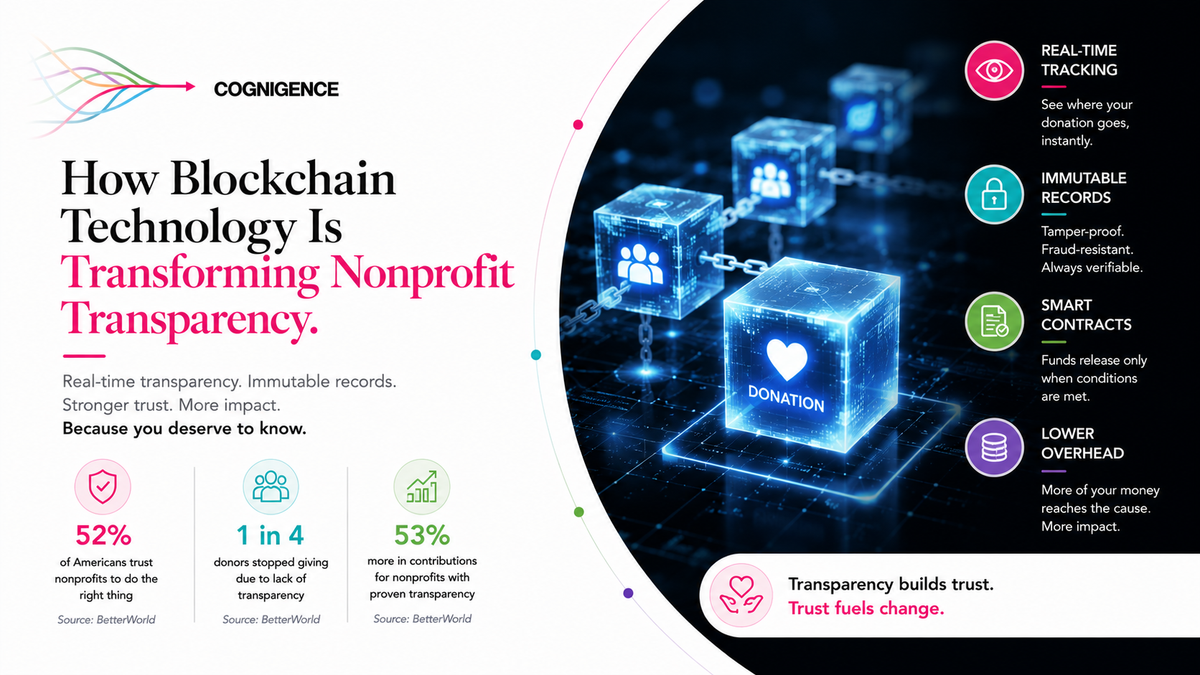
Here is a number that should make every donor pause: only 52% of Americans trust nonprofits to do the right thing. That's not cynicism, that's a sector-wide accountability crisis, and it has a measurable consequence. Nearly 1 in 4 donors say they have stopped supporting a nonprofit specifically because of a lack of transparency about how their donation was used.
Think about what that means. In an era when you can track an Amazon package across three fulfillment centers, watch your investment portfolio move in real time, and get an instant fraud alert when someone buys coffee on your card, charitable organizations are still issuing annual PDF reports and asking donors to trust them. The expectation gap is enormous. And the sector is paying for it in declining donor numbers, reduced small-gift participation, and growing skepticism from the very people who want to help.
Blockchain technology is changing that. Not as a gimmick. Not as a buzzword. As core operating infrastructure that makes it structurally impossible for donations to disappear into an overhead black hole, and makes it structurally possible for donors to verify, in real time, exactly what their gift accomplished.
Cognigence was built on this infrastructure from day one. Our mission and model are structurally inseparable from the blockchain. Here is what that means, why it matters, and how it compares to the way most nonprofits still operate.
The Trust Deficit Is Not an Opinion, It's a Data Problem
The nonprofit sector has a structural information asymmetry problem. Donors hand over money. Organizations receive it. What happens in between is, for the most part, invisible. Annual reports are published months after the fact. Overhead ratios are self-reported. Impact claims are rarely independently verified. A survey cited by BetterWorld found that only 52% of Americans trust nonprofits to do the right thing, and third-party watchdog sites can only evaluate what organizations choose to disclose.
The numbers tell the story clearly. The number of individual donors in the US has been declining for years even as total dollars raised have increased, which means larger gifts from fewer, wealthier donors are masking a collapse in broad-based giving. Small to mid-size donors, those giving $500 or less, who represent 96.9% of all donations, decreased by 14% in 2024. These are the people most deterred by opacity. They are not wealthy enough to demand audited access. They cannot hire advisors to vet organizations on their behalf. They have to trust. And trust is eroding.
Two-thirds of Millennials actively track the results of nonprofits they support. Gen Z, now the largest US generation, overwhelmingly prefers organizations that can demonstrate verified, real-time impact. According to FundsForNGOs's research on blockchain and nonprofit trust, when trust is established through verifiable data, it leads to stronger donor relationships, increased loyalty, and greater willingness to give long-term.
See how Cognigence is built for exactly this at cognigence.org/about.
What Blockchain Actually Is, In Plain Language
Blockchain gets wrapped in so much technical language that its practical function gets lost. Strip it back to the core and it does one thing extraordinarily well: it creates a record of transactions that nobody can alter, hide, or manipulate after the fact.
Each donation is recorded in a "block", a timestamped entry that includes the amount, the source, and where the funds are directed. That block is linked to every previous block in the chain, creating a complete, unbroken history. The chain is stored across multiple computers simultaneously, which means no single person, administrator, or organization controls it. There is no central server to hack, no single accountant to bribe, no report to quietly edit before publishing.
For nonprofits, this means three specific things that change everything: transparency (every transaction is publicly visible), immutability (no entry can be changed or deleted retroactively), and efficiency (no intermediaries taking cuts, creating delays, or adding opacity). Research published in ScienceDirect confirms that all three of these features independently improve donor trust in nonprofits as a measurable outcome. For a broader look at how transparency creates value in the nonprofit world, Harvard Business School's Social Capital Markets report is essential reading.
Four Ways Blockchain Transforms Nonprofit Transparency
1. Real-Time Donation Tracking
The most immediate impact for donors: you can see exactly where your money goes. Not in six months. Not in an annual report. Right now.
Traditional nonprofit accounting runs on quarterly cycles at best. A donation made in January might not appear in any public reporting until the following spring. In the interim, it has passed through bank accounts, administrative systems, and fund allocation processes that are entirely opaque to the person who gave the money. Blockchain collapses that timeline to zero. The moment a transaction occurs, it is recorded and visible. Donors can trace their contribution from the moment it lands in the organization's system to the moment it is deployed to a specific cause, grant, or investment. At Cognigence, every donation to our six focus areas follows this real-time tracking path.
BitGive Foundation's GiveTrack platform demonstrated this at scale, donors tracking contributions in real time, seeing fund allocation as it happened, with detailed information about how each dollar was deployed. The result was measurably higher trust and stronger donor retention.
2. Immutable Financial Records, Fraud Becomes Structurally Impossible
The standard charitable fraud playbook involves manipulation of financial records after the fact. Inflated overhead allocations. Quietly redirected funds. Program expenses that don't match stated priorities. These things are possible, and unfortunately common, in traditional accounting systems because records can be edited.
On a blockchain ledger, this is not possible. Once a transaction is recorded, it is permanent. The cryptographic linking of each block to the previous one means that altering any entry would require re-computing every subsequent block across every node in the network simultaneously, a computational impossibility in practice. The UN World Food Programme understood this when it deployed blockchain for its Building Blocks initiative, using it to track food aid distribution in real time, eliminating fraud and waste at scale while giving donors verifiable proof that resources reached intended recipients.
For donors choosing where to give, this is not a minor technical detail. It is the difference between hoping your money was used as intended and knowing it was. You can read more about how Cognigence applies this at cognigence.org/learn-more.
3. Smart Contracts, Funds That Release Only When Conditions Are Met
Beyond tracking existing transactions, blockchain enables something even more powerful: smart contracts. These are self-executing agreements written directly into the blockchain code. A smart contract can be set to release grant funds only when a research milestone is independently verified. Or to deploy investment capital only when specific eligibility criteria are met. Or to hold operational overhead below a defined ceiling before any program funds are released.
There is no human discretion involved once the contract is set. No administrator can override it. No financial pressure can cause it to release funds prematurely. The conditions are transparent, the execution is automatic, and the result is on-chain for anyone to verify. Giveth uses this mechanism to ensure donations are allocated precisely according to donor specifications, no interpretation, no drift, no discretion.
For Cognigence's grant model, where donor capital funds early-stage research in Cancer, Diabetes, Autoimmune, MedTech, Green Earth, and Underprivileged causes (see all focus areas), smart contract architecture means grants flow to verified recipients when verified conditions are met. Donors do not need to trust the organization's judgment about when funds are released. The blockchain does it for them.
4. Reduced Overhead Through Disintermediation
Every intermediary in a traditional donation chain costs money. Banks charge processing fees. Fund administrators take management costs. Compliance and reporting requirements consume staff time and budget. In a complex international giving structure, a donation can pass through four or five financial intermediaries before it reaches a beneficiary, each one extracting a percentage.
Blockchain removes these intermediaries. Peer-to-peer transaction architecture means funds move directly from donor to cause, recorded in real time, with no banks, clearinghouses, or fund managers taking cuts in between. This is a direct structural mechanism for reducing overhead, and it is precisely why Cognigence is able to operate at $0.25 per dollar on operations while the US nonprofit average sits between $0.50 and $0.80. The blockchain infrastructure is not incidental to that number. It is how that number is possible. To understand how this efficiency translates into measurable social value, read Investopedia's guide to calculating SROI, one of the resources in Cognigence's curated library.
See our full commitment to transparency →
Traditional Nonprofit vs. Cognigence Blockchain Model
Why This Matters More in 2026 Than It Did Five Years Ago
The urgency of blockchain-based nonprofit transparency has sharpened considerably in recent years. Federal funding cuts to major research organizations, growing public skepticism about institutional accountability, and a generation of donors who have grown up with real-time financial tracking as a baseline expectation, all of these forces are converging on the same point: the opaque, trust-me model of charitable giving is not sustainable. CAF America's research on shifting US philanthropy trends documents exactly how rapidly donor expectations are changing.
The data reinforces this directionally. Nonprofits with a proven transparency record average 53% more in contributions the following year compared to organizations that lack that track record. Transparency is not just an ethical obligation. It is a competitive advantage that directly translates into fundraising capacity, and ultimately, more dollars reaching the causes that need them.
The blockchain for nonprofits market is also maturing rapidly. AI-powered fraud detection layered on blockchain data, tokenized impact milestones, decentralized governance frameworks, what was experimental five years ago is operational today. Verified Market Reports' analysis of blockchain nonprofit trends shows the sector is moving fast. Organizations that built on blockchain infrastructure early are positioned to offer capabilities that legacy nonprofits cannot replicate by retrofitting traditional accounting systems. Cognigence was built as a blockchain-native organization from the beginning.
What Blockchain Transparency Looks Like at Cognigence, Step by Step
01. You Choose Your Cause
Cognigence's six focus areas, MedTech, Cancer, Diabetes, Autoimmune, Green Earth, and Underprivileged, are discrete giving channels. Your donation is directed to your chosen cause, not to a general fund. The specificity of the allocation is recorded on-chain from the moment you commit.
02. Your Transaction Is Recorded on the Blockchain
The moment your donation is processed, it enters the Cognigence blockchain ledger. The timestamp, amount, cause allocation, and transaction ID are all recorded immutably. You receive confirmation that your specific transaction exists on the chain, not just a receipt from a database that can be edited.
03. Smart Contracts Govern Fund Deployment
Cognigence's grant and investment deployment is governed by smart contract architecture. Funds are released to research grantees, MedTech investments, or cause-specific programs only when predefined conditions are verified. No discretionary override, no quiet reallocation.
04. Harvard SROI Measures What Your Gift Accomplished
Beyond tracking where your money went, Cognigence applies the Harvard Social Return on Investment framework to measure the value your gift created. Medical research outputs, lives impacted, economic costs avoided, quantified in dollar terms, published in donor-accessible reports. SoPact's breakdown of the SROI calculation methodology is a good primer on how this works in practice.
05. You Can Verify Everything
At every stage, the blockchain record is publicly accessible. You do not need to take Cognigence's word for any of it. The ledger is the proof. Explore our full resource library for the third-party thought leadership that underpins our model, or donate today and experience the transparency firsthand.
The Bottom Line for Donors: What You Should Expect, and Demand
If you give to any nonprofit in 2026 and you do not know where your money went, that is not your failure. That is the organization's failure. The technology to provide complete, real-time, verifiable donation transparency exists, and you can see exactly how Cognigence implements it. It is not expensive or experimental. It is operating right now at organizations that chose to build on it.
The question is not whether blockchain transparency is possible in the nonprofit sector. The question is why more nonprofits have not adopted it, and the honest answer is that transparency is threatening to organizations that benefit from opacity. When donors can see that $0.70 of every dollar goes to operations, the fundraising model collapses. Blockchain does not just improve donor trust; it makes it impossible to hide the things that destroy it.
As a donor, you have the right to know: where did my money go, what did it accomplish, and how much of it reached the cause I chose. At Cognigence, the answer to all three questions is on the blockchain, permanently, publicly, and without the possibility of alteration.
Choose your cause and donate today →
If you're a tax professional or financial advisor looking to guide clients toward verified, high-accountability giving vehicles, visit cognigence.org/tax. For corporate and institutional partnership opportunities, see cognigence.org/partners.